Wrist Pain After the Punching Bag: Why It Happens and What to Do
If your wrist hurts after hitting the bag, stop hitting the bag. Rest it for a day or two. If it isn’t clearly better after 48 hours, see a doctor.
That takes care of today. The rest of this article is about why it happened, because wrist pain on the bag usually has a cause you can fix, and if you come back without changing anything, the same wrist will hurt the same way.
Check your gear first
Gear is the quickest thing to rule out, and it’s the one fix that doesn’t require changing how you punch.
Gloves
Bag work calls for real padding and a glove that holds the wrist. Thin bag mitts and cheap fitness gloves have little of either. Most adults do well with 14 or 16 oz gloves on the heavy bag, and lighter boxers can go down to 12 oz.
Fit matters as much as size. If the glove is too big, your fist shifts around inside it on impact. If it’s too tight, you can’t close your hand all the way. Foam wears out too: after enough rounds it goes flat over the knuckles and the cuff gets soft. If you can feel the bag through the glove, or the glove folds at the wrist when you push on it, replace it.
Wraps
Wraps hold the small bones of your hand together and add support at the wrist. Use 180-inch wraps at the very least, because anything shorter doesn’t have enough length to properly cover the wrist, the hand and the knuckles.
Keep your fingers spread and your wrist straight while you wrap, since a wrap put on over a bent wrist will hold it bent. Go around the wrist several times and keep it snug. If your fingers tingle or change color, it’s too tight and you need to start over. Our guide to the best hand wraps has some options if yours are worn out.
The bag
A bag that’s too heavy or too dense barely gives, so the impact goes back up your arm. A common rule of thumb is a bag of about half your body weight: a 150 pound person is fine with 70 to 80 pounds.
Old hanging bags are a frequent problem. The filling settles over time and packs down toward the bottom until the lower half feels like a wall. Punch lightly at a few heights, and if one area is much harder than the rest, stay away from it until you’ve loosened the filling or replaced the bag. If you’re shopping for one, here are our picks for home punching bags.
Keep your wrist straight at impact
If your gear is fine, look at how the punch lands. At the moment of contact, your forearm and the back of your hand should form a straight line. When the wrist bends, even a little, the joint absorbs force that your arm bones should be carrying. One punch like that won’t do anything. A few hundred in a session will.
Aim to land with your first two knuckles, the ones on your index and middle fingers. They line up with your forearm and have the strongest support behind them. Land on the last two and the wrist tends to buckle, while the small bones behind those knuckles take the load. A break in the bone behind the pinky knuckle is common enough to be called a boxer’s fracture.
Gloves make this hard to notice, because the padding softens a bad landing enough that it feels fine. Try this slow check at the bag:
- Stand at your normal punching distance.
- Extend a jab or cross in slow motion until your glove touches the bag.
- Look at your wrist from the side, or film it with your phone.
- Lean your body weight into the bag through your fist and feel where the pressure goes.
If the wrist wants to fold, or the pressure sits on your pinky side, adjust your fist until the load goes through your first two knuckles and straight into your forearm. Then do the same with your hooks.
Distance matters here too. Stand too close and the punch lands before your arm has extended, which jams the wrist. Stand too far away and you hit at the very end of your reach, where the hand tends to flop. The bag also swings, so the spot that was perfect for the last punch might be wrong for the next one. Move your feet and reset before you hit it again.
Hooks and uppercuts are harder on the wrist than straight punches because the fist comes in at an angle. On the hook, keep your forearm, wrist and fist in one line. If it hurts with the palm facing you, try finishing with the palm down, which supports the wrist better. On the uppercut, stay close and keep it short, since your fist is traveling up into a surface that runs straight up and down. Throw both lighter than your straight punches until they land clean.
How you close your fist
Your hand should stay relaxed for most of the punch and close hard at the moment of contact. Both extremes cause trouble. A loose fist on impact lets the hand collapse and the wrist give way. A fist you keep clenched all round burns out your forearms, the muscles that hold your wrist in place, and by the later rounds the wrist starts to fold.
Keep your thumb outside your fist, folded down across your fingers. Tucked inside the fist or sticking up, it’s in the way of the impact.
On straight punches, rotate your fist as it travels so the knuckles line up when you land. Don’t flick the wrist at the end of the punch to add snap: it stays locked until your hand is on its way back. Our guide on how to throw every basic punch goes through the mechanics of each one.
You might just be hitting too hard
Muscles get stronger faster than tendons do. After a few weeks of training, your arm can produce a punch that your wrist isn’t ready to take yet. A heavy bag makes a great noise when you hit it hard, so it’s tempting to find out how hard that is.
Start at around 60 percent of your power and concentrate on landing clean, then build up over weeks as your wrists adapt. Power comes from the ground and through the hips anyway. A punch muscled out with just the arm adds tension and not much else.
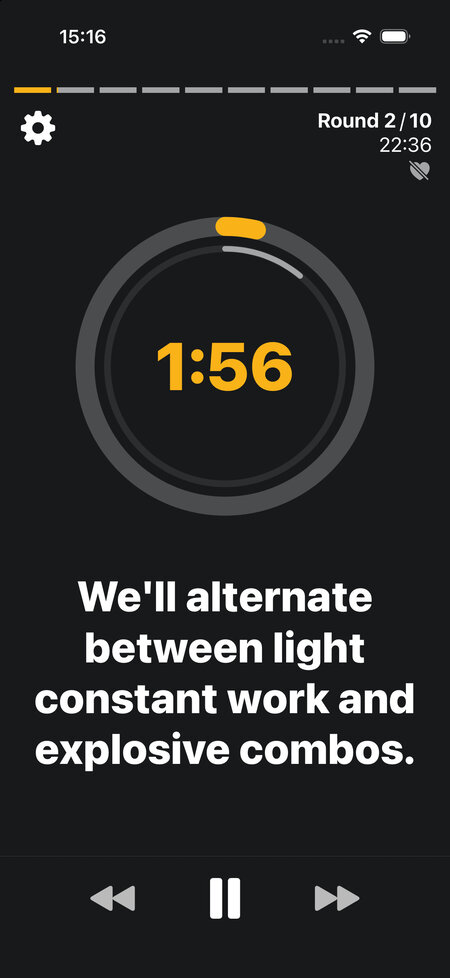
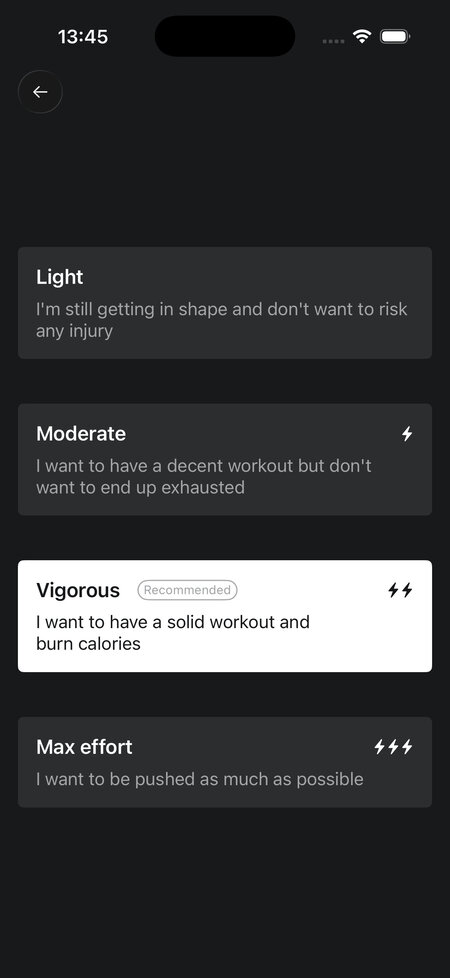
Experienced boxers rarely hit at full power for a whole round, either. Most of your bag work can be light, with the hard punches kept for short bursts. In the Shadow Boxing App, the Punching Bag (explosiveness) exercise works this way: non-stop light punches, then an explosive combo, then back to light work. Your wrist takes far fewer hard impacts than in a round of swinging as hard as you can. If you use Quick Start, turn on the heavy bag option and pick the Light intensity while your wrists get used to the work.
Warm up your wrists
A good boxing warmup gets your whole body ready, and the wrists deserve a little extra attention before bag work. Before you wrap your hands, add a minute of this:
- Wrist circles, about 10 in each direction.
- Open and close your hands 15 or 20 times: fingers spread wide, then a fist.
- Slow wrist bends up and down, about 10 times, without forcing the end of the range.
Then treat your first round on the bag as part of the warmup and keep it to about half power. Cold wrists don’t like sudden impact, and that first round shows you if something feels off before you start hitting hard.
Leave time between bag sessions
Your wrists take an impact with every punch of every round, and tendons adapt and heal more slowly than muscle. A tired wrist also tends to feel fine once you’re warm, so it’s easy to go right back to the bag and let the problem build for a few weeks before it starts to hurt.
If you’re newer to the bag, leave at least a day between bag sessions and add rounds gradually. You don’t have to skip training on the days in between, since shadow boxing uses the same punches without the impact. Watch for the early signs: stiffness in the wrist in the morning, or an ache when you turn a door handle or pick up a pan. Those mean you need more time off the bag. We cover sleep, food and how to plan your week in our article on recovering from boxing training.
Stop sooner than you want to
Many wrist injuries start as a small twinge that someone ignored to finish the round. The timer says 40 seconds left, the pain is minor, and it feels silly to stop.
Pain when you hit the bag is useful, because it shows up while you can still do something about it. At the first twinge, change something right away. Cut your power in half and watch your wrist on the next few punches. Check your distance and your fist. If one particular punch causes it, drop that punch for the day.
If it still hurts on light punches, you’re done. The same goes for sharp pain at any point: end the session right there, even mid-round. Stopping early costs you ten minutes. Pushing through can cost you weeks off the bag.
What to do when your wrist hurts
We make a boxing app and we’re not doctors, so the advice here is simple.
Stop punching, and that includes pads and knuckle push-ups. Don’t wrap it tighter or strap on a brace so you can finish the workout. Rest it, and if it’s sore, a cold pack wrapped in a towel for about 15 minutes can ease it.
Mild soreness from too much bag work usually improves within a day or two. If it isn’t clearly better after 48 hours, see a doctor, and don’t test it on the bag to find out. The wrist is full of small bones, and some injuries don’t feel like much at first. A fracture of the scaphoid, a small bone near the base of the thumb, is often mistaken for a sprain and can heal badly if it’s left untreated.
Don’t wait the 48 hours if you notice any of these:
- Your wrist or hand is visibly swollen, bruised or out of shape.
- You can’t make a fist or grip something.
- Your fingers feel numb or tingly, even with the wraps off.
- You have sharp pain in the hollow at the base of your thumb.
- You felt a pop or a crack when the punch landed.
Getting back to the bag
Once your wrist has stopped hurting and you can make a fist and lift things normally, go back in steps. If you saw a doctor, follow what they told you first.
Start with shadow boxing: the same punches and footwork with no impact. Then try a couple of light bag rounds with your attention on your alignment, and see how the wrist feels the next morning. If it’s fine, add power and rounds gradually over the following weeks. If the pain comes back, stop and get it checked.
The Shadow Boxing App is a boxing workout app built around that first step: it calls out combos while you shadow box with nothing to hit, and it has dedicated bag workouts for when your wrist is ready. It’s free to try.