How to Recover From Boxing Training: Cooldown, Sleep, Food and Rest Days
The first week of boxing often goes the same way. You’re motivated, you train five days in a row, and every session is as hard as you can make it. By the next Monday your shoulders ache when you lift your guard, the stairs feel steep, and the workout you planned gets skipped because you can’t face it. Some people never get past that week.
Recovery is what keeps that from happening. Most of it has nothing to do with ice baths or massage guns, and it starts before you even put your gloves on.
Start with a session you can recover from
The easiest injury to deal with is the one you never get, so look at the training itself first. If a session leaves you too sore to throw a jab for three days, it was too much for where you are right now. Feeling stiff the next day is normal, especially in the first weeks. Losing half your week to it is not.
A few things make a session easier to come back from. Warm up before the first round; we put together a warmup routine you can do anywhere in about 17 minutes. Pick an intensity that fits your level and the day you’re having, not the one you think you should be at. And stop when your technique falls apart. A tired hook with a dropped elbow and no hip rotation is how wrists and shoulders get hurt, and fifty more of them only teach your body the wrong movement.
Learn to tell soreness from pain. Muscle soreness is spread out, shows up a day or two later, and eases once you start moving. Sharp pain in a joint, like the wrist on impact or the shoulder at the end of a cross, is a reason to end the session right there instead of finishing the round.
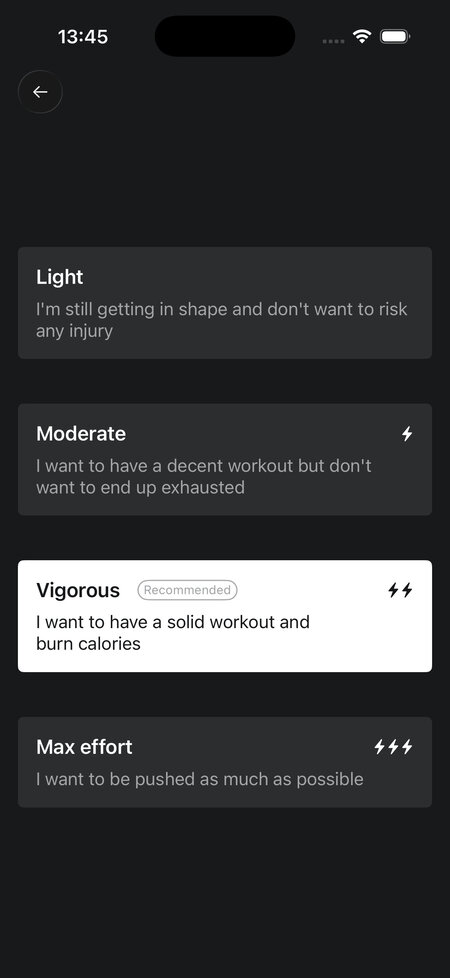
In the Shadow Boxing App, you can pick the intensity yourself in Quick Start or when you build a custom workout. The Light option is meant for people who are still getting in shape and don’t want to risk an injury, and there’s no shame in living there for a few weeks. We went through what each level changes in our article on dialing in workout intensity.
Cool down and breathe
After the last round, the natural move is to drop your gloves and sit on the couch. Your heart is still pounding and your breathing is short, and going from that straight to sitting still can leave you lightheaded. A few minutes of tapering off brings everything down more gradually:
- One or two minutes of very light shadow boxing or walking around the room, hands loose, no power at all.
- Then a couple of minutes of slow breathing, standing or lying on your back.
For the breathing part, make the exhale longer than the inhale. Long, slow exhales help bring your heart rate down, and they give your mind something to do other than replay the round you gassed out in. If you like a structure, 4-7-8 breathing has you breathe in through the nose for 4 seconds, hold for 7, then breathe out through the mouth for 8. We covered why it suits boxers in our article on 4-7-8 breathing.
The app has both of these as cooldown exercises: a simple Deep breaths one and a guided 4-7-8 Breathing one. You can add a cooldown at the end of any custom workout, or launch the two-minute Cooldown workout on its own after a session at the gym or on the bag.
Stretch once you’re warm
Right after the breathing is the best moment to stretch, while your muscles are still warm. Before training, moving through your range works better than holding positions, which is why our warmup and our mobility exercises are built on movement.
Set your expectations, though: stretching after a workout won’t do much for how sore you feel the next morning, and studies on that question have mostly come up empty. What it does is protect the range of motion that boxing slowly takes away. Hours in a guard pull the shoulders forward and tighten the chest. Staying on the balls of your feet loads the calves. Bag work leaves the forearms tight.
Hold each stretch for about 30 seconds, keep breathing slowly, and don’t bounce:
- Chest: forearm against a door frame, elbow at shoulder height, then step through until you feel it across the chest.
- Shoulders: pull one arm across your body with the other hand.
- Hip flexors: half-kneeling lunge, squeeze the glute of the back leg and shift your weight forward.
- Calves: hands on a wall, back leg straight, heel pressed into the floor.
- Forearms: arm straight out, palm up, and gently pull the fingers back with your other hand. Then repeat palm down.
The app doesn’t guide you through stretches, so this part is on you. Five minutes after the breathing is plenty.
Sleep is where the work pays off
Training breaks your body down a little, and a lot of the repair happens while you sleep. Sleep is also when your brain locks in new motor skills, which is why a combo that felt clumsy at the end of a session often comes out cleaner a couple of days later. Most adults need between 7 and 9 hours, and people who train hard tend to need the top end of that.
Two practical points. Hard sessions late in the evening can make it difficult to fall asleep, because your heart rate and body temperature stay up for a while afterward. If evening is your only slot, put the hardest rounds early in the session and give the cooldown a few extra minutes. And after a bad night, lower the intensity. Training hard on four hours of sleep is when coordination slips and ankles roll. Do the light version of the session, or move it to tomorrow.
Eat and drink like you train
You don’t need a meal plan to box a few times a week, but a couple of habits make a big difference.
Protein is what your body uses to rebuild muscle. Spread it across your meals instead of eating it all at dinner; for people who train regularly, a common target is around 0.7 grams per pound of bodyweight per day. After a session, a normal meal with protein and carbs within a couple of hours does the job: eggs on toast, chicken and rice, Greek yogurt with fruit. You don’t need a shake unless it’s convenient.
Water is the one people underestimate. Shadow boxing indoors makes you sweat more than it feels like, especially with the windows closed. Drink through the whole day, not only during the workout. If you want a number, weigh yourself before and after a session; each pound you lost is roughly 16 to 24 ounces of water to drink back over the next few hours.
Timing matters a little too. A big meal in the hour before training makes slipping and rolling miserable, and a hard session on a completely empty stomach can leave you dizzy halfway through. A light snack an hour or so before is usually the sweet spot.
Give your week a rhythm
Your body adapts in the gap between sessions. A week of back-to-back hard workouts doesn’t leave it any gap to work with, and that’s when people get stuck feeling tired all the time without getting any better.
The simplest rule is to never put two hard sessions on consecutive days. Between them, either take the day off or keep it light. A light day means shadow boxing at a pace where you could hold a normal conversation, which is exactly how the app describes its Light intensity: slow combos, footwork, relaxed defense. A lot of technique gets fixed on those days, because you’re moving slowly enough to notice what you’re doing.
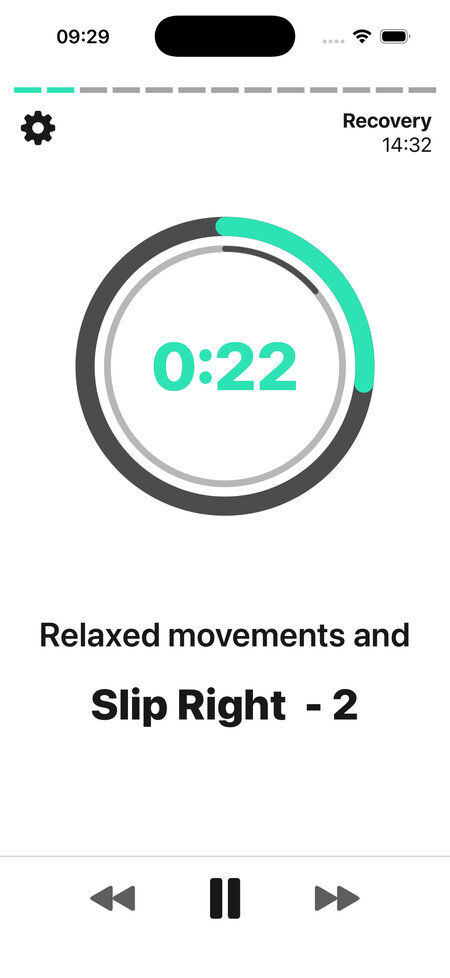
The app uses the same idea inside a single workout: between the harder rounds, recovery segments ask for relaxed movements and simple defense so you slow down without stopping. And when you want to train but your body says otherwise, the Light workout is there for that. Its description sums it up: “No day off, but maybe it’s been a rough week.”
Here’s what a week could look like for someone training four times:
- Monday: hard session
- Tuesday: off
- Wednesday: light technique session
- Thursday: hard session
- Friday: off
- Saturday: moderate session, or a long walk
- Sunday: off
If you’re just starting, three sessions a week with only one of them hard is a good first month.
Watch for signs you need more rest than you’re taking: soreness that’s still there when the next hard session comes around, a resting heart rate that’s higher than usual in the morning, sleep getting worse, punches that feel slow, or not wanting to train at all. One of those on its own is a bad day. Several at once mean it’s time for a few easy days.
Planning rest days also shouldn’t cost you your streak. In the app, you pick which days of the week you plan to train, and the streak is counted in weeks based on that plan, so a rest day you scheduled never breaks it. The progress calendar then shows your training days in green, gaps included.
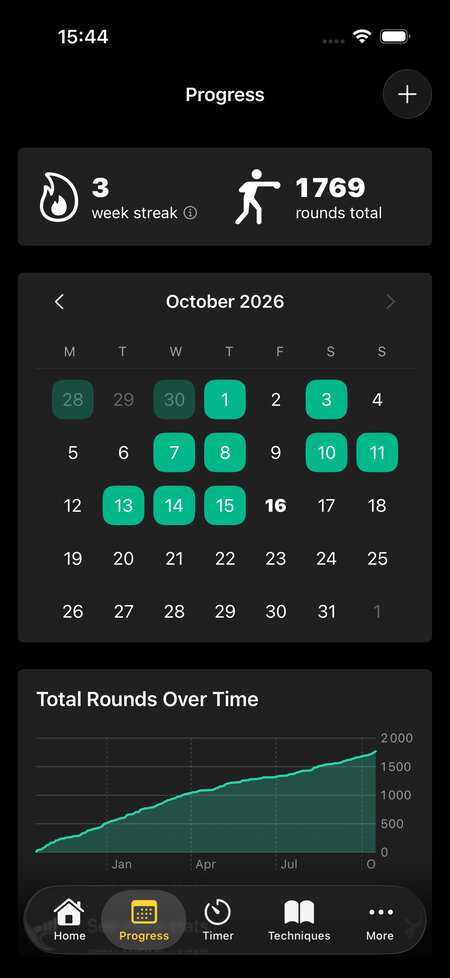
Clinton, who has done 1,800 rounds over two years with the app, listed “staying remarkably injury-free while still making consistent progress” among the biggest benefits of training this way. Two years of boxing is built on being able to show up again next week, and that comes down to all the unglamorous stuff above.
If you want workouts with an intensity you control, a breathing cooldown at the end and a light option for rough days, the app is free to try.