
How to Warm Up for Boxing: A Simple Routine That Works Anywhere
You put your gloves on, the timer beeps, and you throw your first 1-2 of the day. The shoulder feels tight, the hips do not want to rotate, and the punch comes out slow and stiff. Most people push through that and call the first round their warmup. It works until the day it does not, and a tweaked shoulder or a sore lower back takes weeks to go away.
How long a warmup should take depends on the workout you are about to do and on your own body: a long sparring session needs more than a quick bag round, and an older boxer or someone coming back from an injury needs more than a twenty-year-old. The principles stay the same though. For this article we will take an average person with no health issues as the example, which puts the warmup at about 17 minutes. Here is one you can do in a living room, a hotel room or a gym with no equipment at all, and then a look at how the Shadow Boxing App can run it for you when you would rather not think about it.

What a boxing warmup needs to do
Boxing asks a lot of a few specific areas: shoulders, hips, neck, ankles and the whole chain that turns a punch from the ground up. A warmup that only raises your heart rate leaves those joints cold. A warmup that is only stretching leaves you with loose joints and a resting pulse, which is not much better when the first round starts at full speed.
The routine below goes through three steps in order, and the order matters:
- Mobility, to move each joint through its range before you load it, with slow, deliberate breathing throughout.
- Raising your heart rate, so the first round is not the shock that wakes your body up.
- Light shadow boxing, to rehearse the actual movements at low speed.
Breathing is not a step on its own, but it runs through all three. It gets the most attention during mobility, because that is the one moment in the session where you are moving slowly enough to notice it.
Each one feeds the next. Mobility makes the cardio movements cleaner, the cardio makes the shadow boxing feel loose, and by the time the workout proper starts you are already moving like a boxer.
A 17-minute warmup without any equipment
Step 1: Mobility (8 minutes)
Work from the top down. Spend about a minute on each, slow and controlled, no bouncing at the end of the range. Eight minutes sounds like a lot for mobility, and it is longer than most people give it, but this is the step that actually prevents injuries, so it gets the biggest share of the warmup. Before you start, take a few slow breaths in through the nose and out through the mouth, and keep that pace going the whole way through. The breath is the metronome for every movement here.
- Neck: nod yes, shake no, then tilt ear to shoulder on each side.
- Shoulders: big arm circles forward, then backward. Add a cross in front of the chest on each swing.
- Torso: twist side to side with your arms loose, letting your hips follow.
- Hips: hip circles both ways, then a few deep squats where you hold the bottom position for a full breath in and out.
- Hip flexors and legs: yoga lunges. Step one foot forward into a long lunge, back knee down or hovering, and sink into the front hip for a couple of slow breaths. Reach the arms overhead if you want more from the shoulders too. Switch sides.
- Ankles and knees: knee circles, then rock up onto your toes and back down.
Pay attention to the breathing more than the stretching. Breathe in as you open up, for example as the arms swing back or you reach overhead, and breathe out as you fold or twist. Most people hold their breath the moment a movement gets a little uncomfortable, and that is exactly the habit that shows up later as a tense shoulder on the hook or a beginner who forgets to exhale as soon as they get tired. Eight minutes of matching breath to movement also pulls your attention onto the session instead of whatever you were doing before. For the last few breaths, add a short sharp exhale at the end, the kind you make when a punch lands. That is the sound you will use for every punch for the rest of the session.
If you want more detail on why each of these movements matters and how to do them well, we broke the whole thing down by body part in our article on mobility exercises before boxing. If you want a structured breathing pattern to use before or after a session, the 4-7-8 breathing one is a good place to start.
Step 2: Raise your heart rate (3 minutes)
Now get your pulse up. Nothing here should be at full effort; the goal is to be breathing a little harder and starting to sweat, not to be tired before you begin. Keep the exhale on each punch you add, it is the same sharp breath you practiced a minute ago.
- Thirty seconds of jogging in place or jumping jacks.
- Thirty seconds of bouncing on your toes in your stance, like you are skipping without a rope.
- Thirty seconds of squats with a punch at the top of each one.
- Thirty seconds of high knees with a jab on each knee.
- Repeat the block once.
If you have a jump rope, you can swap the whole block for three minutes of skipping instead. It is not better than the movements above, just another option, and a common one in boxing gyms. Keep it easy: a basic bounce for the first minute, then the boxer skip once your legs are in, with a few side-to-side or high-knee variations if you know them. No double unders, no sprints, nothing that gets you gasping. Use whichever you feel like that day, or alternate between the two.
Step 3: Light shadow boxing (2 rounds of 3 minutes)
Finish with two rounds of shadow boxing at maybe half speed and half power, with a short break in between. Stick to short combos, nothing longer than three punches, and spend as much time moving your feet as throwing. Step in and out, pivot, slip a couple of imaginary punches. Exhale on every punch and breathe in between combos. Pay attention to how the shoulder feels on the hook and how the hips feel on the cross. If something still feels tight after the first round, use the break to give it another thirty seconds of mobility, then let the second round pick up a little speed and a little more footwork.
The point of these rounds is rehearsal, not work. You are not trying to hit hard yet. You are checking that everything moves the way you want it to before you ask it to move fast.
That is the whole thing. Around 17 minutes for most people, no equipment, and you walk into the first real round already warm. Stretch each step out if you are older, sore or about to do something long and hard; shorten the cardio block if the session itself is short. We go into why skipping it costs more than it saves in our article on why every boxing session needs a good warmup.
Letting the app run it for you
Doing this on your own works fine. The problem is consistency. On a day when you only have twenty minutes, the warmup is the first thing to get cut, and on a day when you are motivated you tend to rush through the mobility part to get to the punching.
The Shadow Boxing App has a guided warmup built in that follows the same three-step structure: mobility first, then cardio boxing to raise the heart rate, then light shadow boxing with simple callouts. It is timed, it tells you what to do and it shows you a short video of a coach doing it, so you cannot really skip the neck circles because you forgot about them.
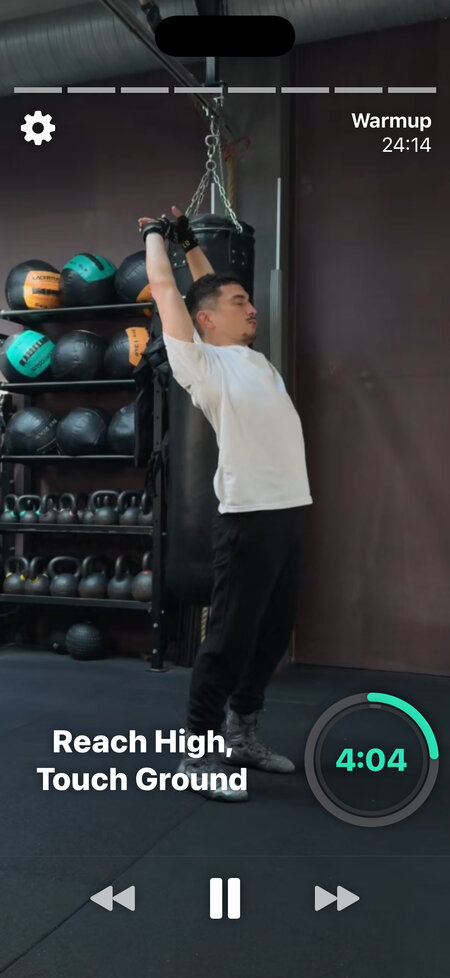
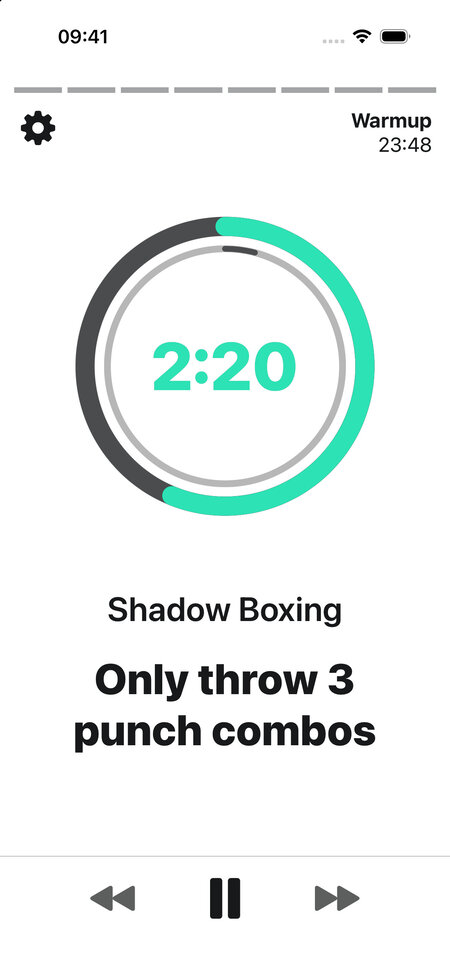
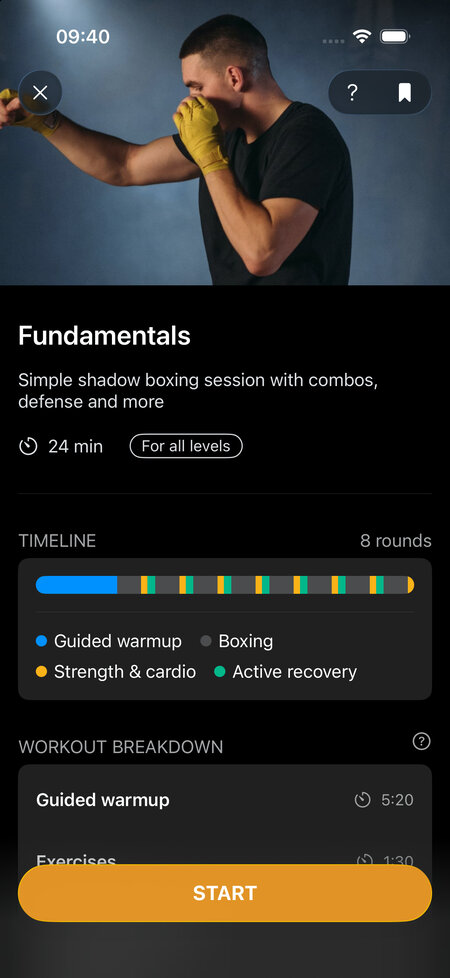
The warmup is not a separate thing you have to remember to launch. When a workout includes one, it shows up as the first block in the workout timeline, before the boxing rounds, and the breakdown underneath tells you how long it will take. Below is the Fundamentals workout, where the warmup takes a little over five minutes out of a 24-minute session.
One thing to be clear about: not every workout in the app includes a warmup. It depends on the workout. A long session built around combos and defense will have one, because you are going to be throwing a lot of punches for a long time. A short, easy session or one designed to be slotted into the middle of another training session may not, because adding five minutes of mobility to a ten-minute workout does not make sense.
That default is a judgment call, and some people disagree with it. Some always want a warmup, no matter how short the session, because they know their shoulders. Others always warm up on their own before opening the app and do not want to do it twice. So the app lets you pick. In the preferences there is an Include warmup setting with three options: based on workout, which is the default described above, always, and never.
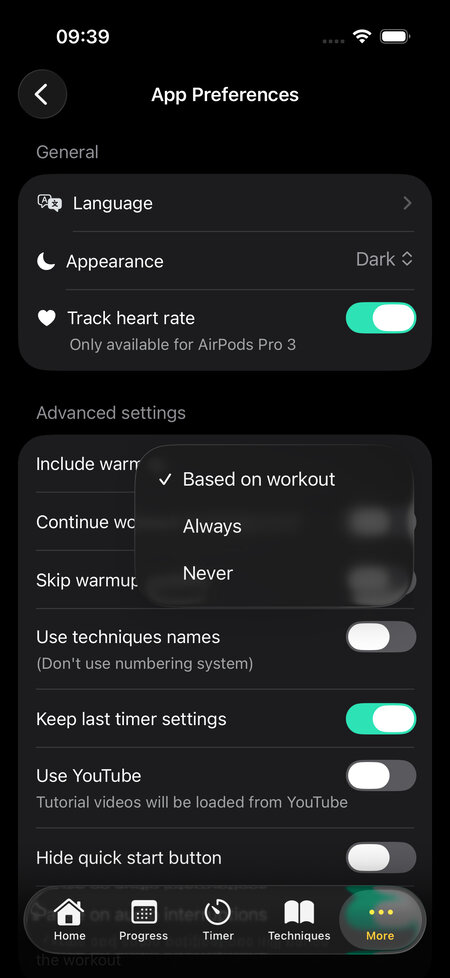
It is a small thing, and it is the kind of small thing we spend a lot of time on. We wrote about a few others in our article on the app settings. A setting like this one exists because training is a habit, and the details that get in the way of a habit are the ones that matter most.
If you want to see what the guided warmup looks like round by round, we described it in detail when we rebuilt it earlier this year.
Keep the structure, change the exercises
The order above is the part to keep: mobility, then cardio, then light shadow boxing. The exercises inside each step are not sacred. Once you have done the routine a few times and know what being warm feels like for you, swap things around. Trade the arm circles for arm crosses one day, the jumping jacks for a minute of skipping, the squats with punches for lunges with punches. Pick different combos for the shadow boxing round.
Two reasons to do this. The first is that the same 17 minutes every single session gets boring, and a boring warmup is the one you start skipping. The second is that different movements wake up slightly different things, so rotating them covers more ground over a week than repeating one fixed list.
The one rule is that you have to be warm at the end. If you swapped out the shoulder work and the hook still feels stiff in the first round, that swap did not work and you go back to it. Pay attention to your body, not to the list.
This is also what the app does. The guided warmup keeps the same three phases every time but mixes up the exercises within them, so one session starts with neck mobility and arm rotations and the next with hip circles and a reach overhead, and the cardio block alternates between things like shoe shine, high knees with punches and squats with punches. You still get a complete warmup, you just do not get the same one twice in a row.
Try the routine for a couple of weeks and start swapping exercises once it feels familiar. If you then want a version that is timed, guided and already varied for you, the app is free to try.