
How Hard Should You Shadow Box? Four Intensity Levels and What to Do at Each
Most of your shadow boxing should happen somewhere between moderate and high intensity, with light rounds to warm up and recover, and max effort saved for short bursts. Going all out every round feels productive, but it wears down your technique and leaves you with nothing for the moments that are supposed to be hard.
The tricky part is knowing what “light” or “high” actually means when there’s no opponent and no bag, and what to do with your hands and feet once you’ve picked a level. That’s what this article is about.
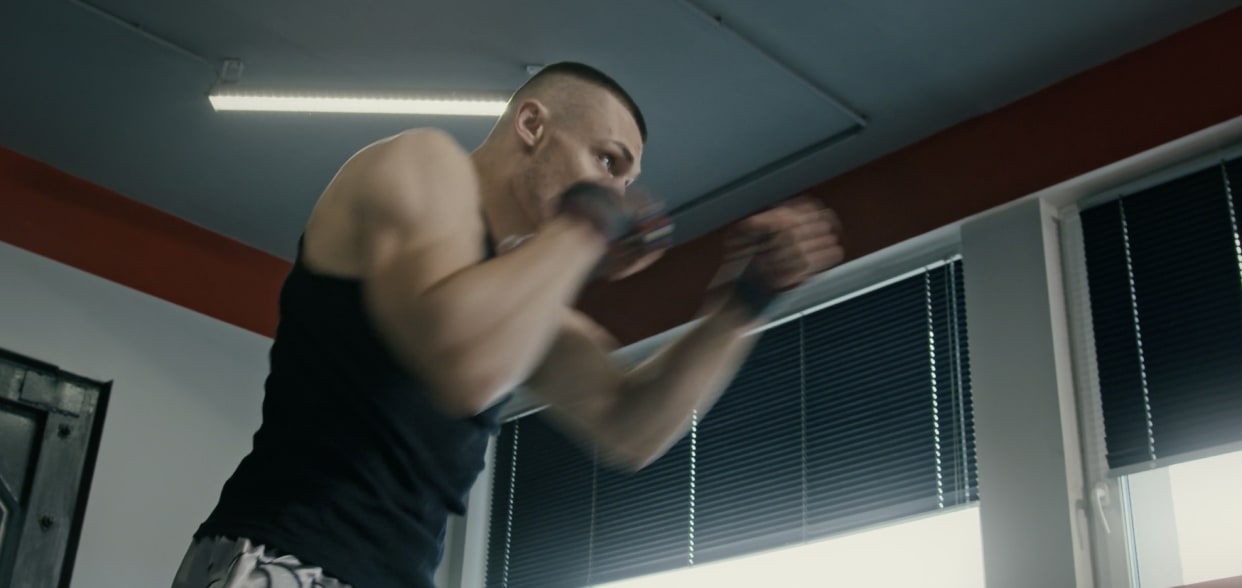
The four intensity levels at a glance
| Level | Feels like | What you focus on | When to use it |
|---|---|---|---|
| Light | You could hold a conversation | Technique, staying loose | Warm-up, recovery rounds, learning something new, easy days |
| Moderate | You could say a few sentences | Good form at a pace you can hold | Most of your training sits between moderate and high |
| High | You could get out one sentence | High output, still in control | Most of your training sits between moderate and high |
| Max | A word or two at most | Full power and speed | Short bursts, the last round, not every day |
The “feels like” column is the talk test: how much you could say out loud at that effort. It’s a simple way to gauge intensity without a heart rate monitor, and it’s one of the methods the CDC suggests for measuring exercise intensity.
This short video walks through all four levels and what each one looks like:
Four Gears: how we think about pacing shadow boxing
Four Gears is the way we pace freestyle shadow boxing: before each round, pick one of four intensity levels, and let that level decide what you work on, not just how fast you go.
That second part matters: each gear has its own job, and the ideas below are built around that job. A light round is where you fix your jab. A max round is where you find out whether your jab survives when you’re exhausted.
Light: low effort, focus on technique and stay loose
At light intensity, your breathing barely changes. Your shoulders stay relaxed, your hands come back to your face without effort, and you have all the attention you need to notice what your body is doing.
That attention is the whole point. Light rounds are where technique gets built, because you’re not too tired to care about it.
What to do in a light round
- Slow-motion combos. Take a combo like jab, cross, lead hook and do it at half speed. Watch the hip turn on the cross, the pivot of the lead foot on the hook, the rear hand staying glued to your chin. Speed hides mistakes; slowing down shows them.
- One punch, done well. Spend a whole round on the jab. Step in with it, step back with it, double it, jab to the body. It sounds boring, and it’s one of the most useful rounds you can do.
- Footwork with no punches. Move forward, back, side to side, pivot. Keep your stance the same width the whole time and never cross your feet. Add punches only once the feet feel automatic.
- Defense flow. Slip, roll, slip, block, with no punches at all. Then add a single punch after each defensive move so you get used to answering.
- Check yourself in a mirror or a window. Is your chin down? Does your rear hand drop when you jab? Light rounds are the only ones where you have the bandwidth to look.
- Breathe on purpose. Short exhale through the nose or mouth with each punch. If you hold your breath at light intensity, you’ll hold it everywhere.
When to use light intensity
- Warming up. The first round or two of any session. Our guide on how to warm up for boxing goes further, but a light round of shadow boxing is the most boxing-specific warm-up there is.
- Recovery rounds. Between hard rounds, a light round lets your heart rate come down while you keep moving. This beats standing still with your hands on your hips.
- Learning something new. A new combo, a new defense, a pivot that still feels awkward. Learn it light first, then speed it up.
- Easy days and tired days. When you’re sore or short on sleep, a full session at light intensity still counts. It’s also the best option late at night when you need to stay quiet.
- Cooling down. The last few minutes of a session, before stretching.
Moderate: work at a sustainable pace with good form
Moderate intensity is your everyday working pace. Most of your training sits somewhere between moderate and high, and that’s how most workouts in the app are paced. You’re working, you’re sweating a bit, your breathing is up, but you could keep this pace for a long time. Your form should look the same in the last ten seconds of the round as in the first ten.
If you’re a beginner, almost all of your rounds should be here or lighter for the first few weeks.
What to do in a moderate round
- Pick a theme for the round. One idea, kept for the full round: jab and move, head and body, every combo ends with a step out. We go deeper on this in our article on what to do in freestyle bag rounds, and the same themes work in the air.
- Build combos in layers. Start with 1-2. Every thirty seconds or so, add a punch: 1-2-3, then 1-2-3-2. When the combo gets long, add a defensive move at the end.
- Picture an opponent. Give them a height, a stance, a habit. Maybe they jab a lot, so you slip and counter. Maybe they’re shorter and come forward, so you work your jab and move off to the side. Having someone to box makes every punch and every step have a reason.
- Use the whole room. Cut angles, circle in both directions, step in and out. If you end the round on the same square foot of floor, your feet weren’t part of it.
- Mix levels. Jab to the head, jab to the body. Bend at the knees, not the waist, so you can still see your imaginary opponent.
- Defend after every combo. Never let a combo end with you standing in front of your opponent. Slip, roll, step out or pivot after the last punch.
When to use moderate intensity
- The bulk of any session. Once you’re warm, most of your work should land between moderate and high.
- Longer workouts. Forty minutes at high intensity isn’t realistic. Forty minutes at moderate is.
- Practicing technique under a bit of fatigue. Light rounds build the technique; moderate rounds check that it still holds when you’re breathing harder.
- Beginners, most days. The shadow boxing workout plan for beginners keeps you mostly at this level, and that’s on purpose.
High: push hard, high output, stay in control
At high intensity, you’re breathing hard and the round feels long. You’re throwing a lot of punches and moving a lot. The difference with max is control: your hands still come back, your feet still land in stance, and you still defend.
A good test: if someone filmed this round and played it at half speed, would it look like boxing, or like flailing? High intensity should still look like boxing.
What to do in a high-intensity round
- Burst and reset. Throw a fast four- or five-punch combo, move out, take two or three seconds to reset your stance, and go again. Keep repeating until the bell.
- Constant pressure. Picture an opponent who’s backing up. Walk them down with your jab, cut off the ring, and throw combos when they run out of room.
- Punch, defend, punch. Combo, slip, combo, roll, combo. The defense keeps you honest about your guard when you’re tired.
- High volume straights. Fast jab-cross for ten seconds, then move for ten seconds, then go again. Keep the punches snappy and pull them back as fast as you send them out.
- Never stop moving. Even between combos, your feet keep working. Small steps, bounce if you like, change angles.
When to use high intensity
- The working part of a session. Once you’re warm, most of your rounds sit between moderate and high. Push toward high when you feel good, and ease back toward moderate when you need to get your breath back without stopping.
- Conditioning days. When the goal is cardio, high intensity rounds with short rest give you most of it.
- When moderate starts to feel easy. That’s the sign you can spend more of your rounds at high.
- Not when you’re learning. New technique falls apart at this pace. Keep it for things you already know well.
Max: give everything you have
Max intensity is full power and full speed. You won’t hold it for long. Talking isn’t an option, and that’s fine: max is about short efforts, not long rounds.
The risk at this level is that technique disappears completely. Your guard drops, your punches start to swing, your stance collapses. The goal is to go as hard as you can while keeping enough form that it’s still boxing.
One thing to watch out for: when you punch at full power into the air, there’s no bag to stop your arm. Don’t let your elbow snap straight at the end of a punch. Stop just short of full extension and pull the hand back. Your elbows will thank you.
What to do in a max-intensity round
- Flurries. Ten to fifteen seconds of non-stop fast punches, then a few seconds of movement, then again. Straights are easier to keep clean at this speed than hooks.
- Empty the tank at the end. Go moderate or high for most of the round, then max for the last thirty seconds.
- Speed over power, or power over speed. Pick one. A round of fast straight punches feels nothing like a round of heavy hooks and uppercuts thrown with full hip rotation, and both are hard.
- Keep a minimum standard. Choose one thing that must not break: hands back to the face, or chin down. If it breaks, slow down for a few seconds, then go again.
When to use max intensity
- The last round of a session. When you have nothing to save energy for.
- Short bursts inside other rounds. Ten seconds of max inside a moderate round is a great way to train it without wrecking the whole session.
- A couple of times a week at most. Max efforts take time to recover from. Our article on how to recover from boxing training explains why going hard every day backfires.
- Not in your first weeks. Get your technique solid at light and moderate first. Max intensity just makes bad habits faster.
How to mix the four levels in one session
Here’s what a 20-minute Four Gears session can look like, with six rounds of 2 minutes and short rest between them:
- Round 1, light. Footwork, single punches and slow combos. Loosen up.
- Round 2, moderate. Theme: jab and move.
- Round 3, high. Burst and reset.
- Round 4, moderate. Theme: every combo ends with a slip or a pivot.
- Round 5, high. Constant pressure.
- Round 6, moderate, then max. Moderate pace, and the last 30 seconds all out.
Then a minute or two of light movement to come back down. If round 5 leaves you wrecked, drop round 6 to light instead of skipping it. The plan should fit the day, not the other way around.
Mistakes people make with intensity
- Every round at max. It feels like hard work, but your technique gets worse every week and you never fully recover. This is the most common one by far.
- Never leaving light. The opposite problem. If you never get out of breath, your technique hasn’t been tested yet.
- Starting hot and fading. Going high in the first minute and dragging through the second. Pick the level before the round and hold it from bell to bell.
- Judging intensity by how fast your hands move. Footwork, defense and movement count too. A high round with fast hands and still feet isn’t really high.
Intensity in the Shadow Boxing App
In the Shadow Boxing App, all four levels are in the technique catalog, under Shadow Boxing, each with a short video showing what it looks like. They’re useful to watch before a freestyle round if you’re not sure what “high” should feel like compared to “moderate”.
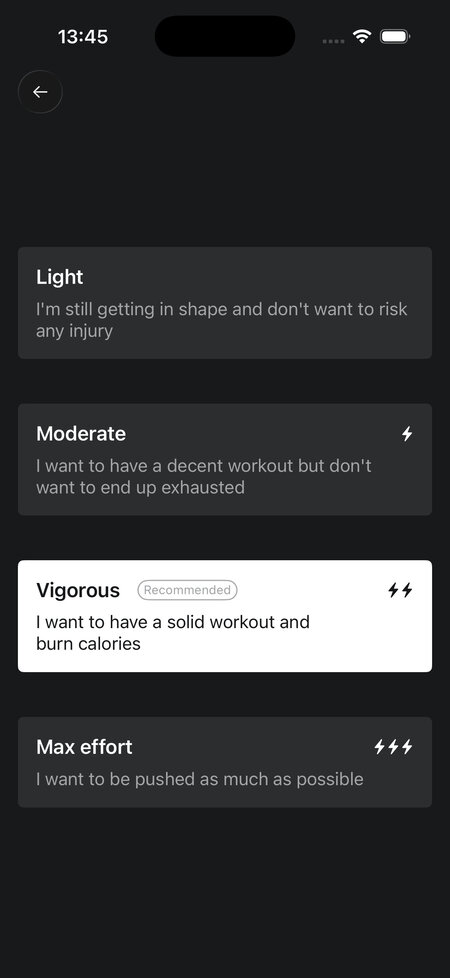
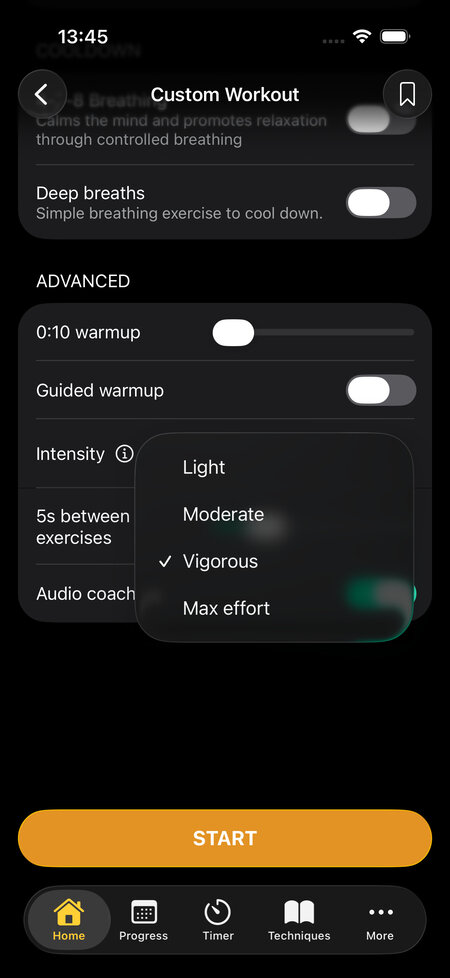
Workouts also have an intensity setting, with four options from Light to Max effort. You can pick it when you use Quick Start or build a custom workout. It changes how the workout runs, like the time between combos and how complex some exercises get, so a Light workout is gentler throughout and a Max effort one keeps you busy.
Some workouts also include a Light Freestyle exercise as a recovery round: light shadow boxing to get your energy back before the next effort. That’s the light gear in action, so treat it that way: loose, moving, breathing.