
Shadow Boxing Workout Plan for Beginners: 12 Sessions to Get Started
Most people start shadow boxing the same way. They clear some space in the living room, start a timer and punch the air until their shoulders give out. The next session looks exactly the same, and so does the one after that. A month in, they’re still throwing the same 1-2 and they’ve never once moved their head.
Punching air is fine. Punching air without a plan means you only ever repeat what you already know. Here’s the plan we’d give someone starting from zero: twelve short sessions, one new skill in each, and defense much earlier than most beginners would add it on their own.
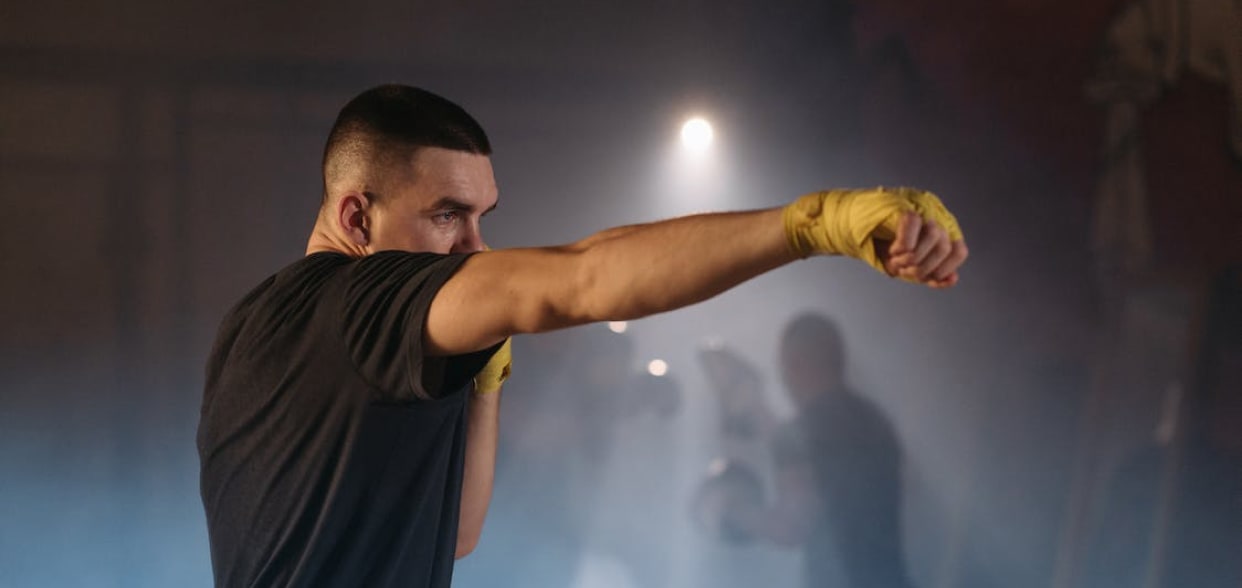
The 12-Session Shadow Boxing Plan
The 12-Session Shadow Boxing Plan is our beginner progression: each session adds one skill on top of the previous ones, starting with stance, footwork and straight punches, moving to defense as soon as you know all six punches, and ending with freestyle rounds and a harder conditioning workout.
| Session | Focus | What you add |
|---|---|---|
| 1 | First punches | Stance, basic footwork, jab and cross |
| 2 | Hooks | Lead and rear hooks, first combos |
| 3 | Uppercuts | Lead and rear uppercuts |
| 4 | All punches | Combos mixing all six punches |
| 5 | Body shots | Changing levels to punch to the body |
| 6 | Pad work | Reacting to combos called out loud |
| 7 | Basic defenses | Block, slip, roll, parry |
| 8 | More defenses | Step back, lean back |
| 9 | Freestyle | Rounds where you decide what to do |
| 10 | Combos | Longer combos with defense built in |
| 11 | Review | A full workout using everything so far |
| 12 | HIIT | A harder, faster session |
Do three or four sessions a week and you’ll finish in three to four weeks. They don’t need to be on back-to-back days, and if a session felt shaky, do it again before moving on. Repeating session 4 is a better use of your time than reaching session 12 with sloppy hooks.
What each session looks like
Every session follows the same shape, and none of them should take much more than half an hour:
- Warmup, about 5 minutes. Loosen your neck, shoulders and hips, then get your heart rate up. If you need ideas, here’s a simple boxing warmup.
- Learn the new skill. Watch a short tutorial on what you’re adding that day, then try it slowly ten or twenty times until it feels less awkward.
- Rounds. Three to six rounds of 2 to 3 minutes, with about a minute of rest between them. Use the new skill in every round, mixed in with what you already know.
- Cooldown. A few minutes of slow movement and stretching.
The first sessions are short on purpose. Your shoulders aren’t used to holding a guard up for minutes at a time, and they’ll let you know the next morning.
Sessions 1 to 3: learn footwork and the basic punches
Session 1: stance, footwork, jab and cross
Everything starts from your stance. Feet a little wider than your shoulders, lead foot forward (your left foot if you’re right-handed), body turned slightly sideways, knees soft, rear heel a little off the ground. Hands up by your cheekbones, elbows in, chin down. The stance video from the program shows all of it in one go.
Then learn to move without losing that position. The basic rule of boxing footwork: the foot closest to where you’re going moves first, and the other one follows by the same distance. To go forward, step with your lead foot and bring the rear foot up. To go back, the rear foot moves first. Never cross your feet and never bring them together. Spend a full round doing nothing but moving forward, back and to each side with your guard up. It’s boring, and it’s also the part most beginners skip and regret later.
The jab comes next. It’s the punch you’ll use the most: fast, straight from your lead hand, and back to your face as quickly as it went out. Watch the jab video from the program before you try it, and if you want a detailed breakdown, read how to throw every basic punch. Then add the cross from your rear hand, turning your hips and pivoting on your rear foot, and you have the 1-2.
One habit to start right away: after every 1-2, take a step back out of range. It’s the simplest defense there is, and doing it from the first session means you never get used to standing still in front of an opponent after you punch.
Sessions 2 and 3: hooks and uppercuts
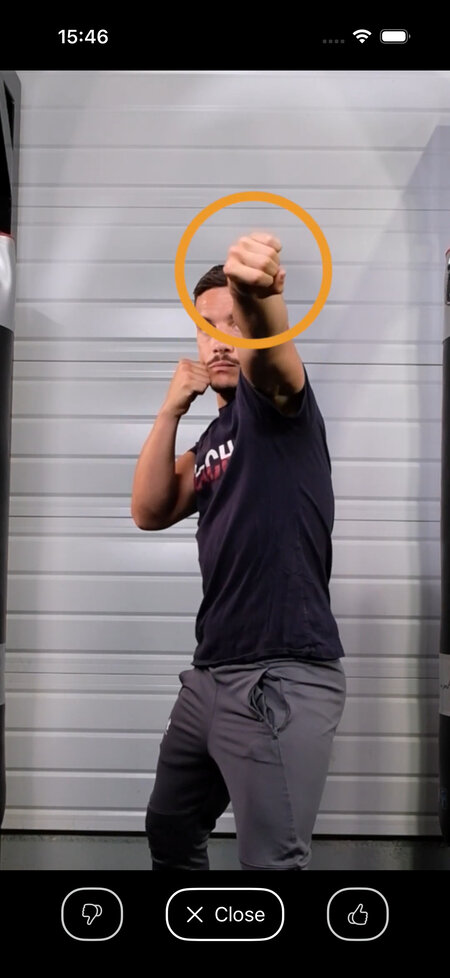
You don’t need weeks of jabs before you’re allowed to hook. In session 2, add the lead and rear hooks: elbow raised to about the height of your fist, a short arc, and your body turning the punch instead of your arm swinging it. With four punches you can start on your first real combos, like the 1-2-3 (jab, cross, lead hook) and the 1-2-3-4.
Session 3 brings in the uppercuts. They tend to feel the most awkward at first because the power comes from your legs: bend your knees a little, then push up as you turn and drive the fist upward. Keep them short. A wide, looping uppercut leaves your chin open for a long time.
Boxers number the punches, and it’s worth learning the system now since that’s how coaches and apps call out combos. 1 is the jab, 2 the cross, 3 the lead hook, 4 the rear hook, 5 the lead uppercut and 6 the rear uppercut.
Sessions 4 to 6: get moving and keep moving
By session 4 you know all six punches. The next three sessions are about using them while staying on your feet, and this is where shadow boxing starts to feel like boxing.
Mix all six punches in short combos and move between each one. Step in to punch, then step out or to the side. If you notice you’ve been planted in the same spot for 30 seconds, you’ve stopped boxing. The same goes for when you get tired: slow down, keep your hands up, jab and move. Don’t stand in the middle of the room catching your breath while the clock runs. Nobody gives you a break in a real round because you’re tired, and pushing through those moments at a lower pace is how your stamina improves.
Bodyweight work between rounds helps here. A short round of squats with punches or high knees while punching keeps your heart rate up and makes the next boxing round harder in a useful way.
Session 5 adds body shots. Bend your knees to lower your level instead of leaning forward or just aiming your fist lower. Your head should come down with the punch so you stay balanced and protected. Mixing head and body is one of the first things that makes your combos look aimed at a person.
Session 6 is pad work, and it changes something important: you stop choosing the combos. On the pads, a coach holds them up and you react. You can’t get that from a mirror, but you can get it by having someone call out numbers, or by using an app that does it for you. Reacting to a “1-1-2” called out of nowhere is a different skill from throwing a 1-1-2 you planned, and it’s much closer to what boxing asks of you.
Sessions 7 and 8: get to defense early
A lot of beginners put off defense for months because nothing comes back at them when they punch air. That’s the reason it should come early. Every round you spend punching without defending teaches you to stand still with your chin up after a combo, and that habit is hard to undo once it’s there.
Session 7 covers the basic defenses:
- Block: catch the punch on your gloves and forearms with a tight guard.
- Slip: move your head off the line of a straight punch by turning your shoulders and bending slightly at the knees. Our guide on how to slip a punch goes into more detail.
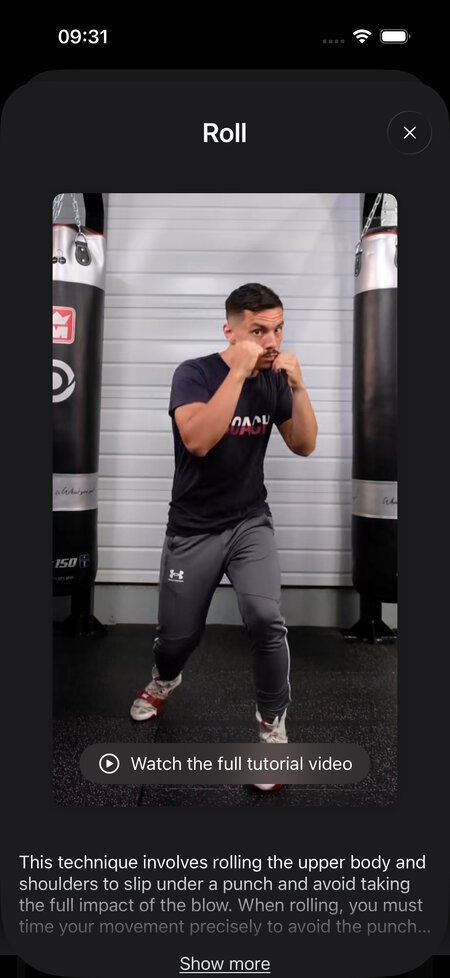
- Roll: bend your knees and move your head under a hook in a U shape, coming up on the other side. The roll video from the program shows the movement better than a description can.
- Parry: tap a straight punch aside with your hand at the last moment.
Session 8 adds the step back and the lean back, two ways to make a punch miss by changing the distance instead of moving your head to the side.
From here on, finish every combo with a defensive move or a step out of range. Picture the counter coming back after your 1-2-3 and roll under it, or slip the jab you’d expect after your 1-2. Of everything in this plan, that rule is the one that changes your shadow boxing the most.
Sessions 9 to 12: freestyle, combos and a harder workout
Session 9 is freestyle: a timer and you, with no callouts and no instructions. You decide what to work on, which makes it a good test of what has stuck so far. Plenty of beginners find out here that they fall back on the same two combos and forget about their feet. That’s normal, and it’s useful to notice. The shadow boxing tips video from the program is worth watching before the first round.
Session 10 builds longer combos with defense in the middle as well as at the end, like 1-2, slip, 2 or 1-2, slip, roll, 3. Session 11 is a review: a full workout that pulls from everything so far. If one part of it falls apart, go back to the session that covered it before moving on. Session 12 is a HIIT workout with shorter rests and a higher pace, and a good way to see how far your conditioning has come since session 1.
Keep your shadow boxing realistic
Picture a real opponent
Shadow boxing only works if someone is standing in front of you. Before each round, put an imaginary opponent at a real distance, close enough that your jab would just reach their chin. Punch at them, move around them, and when you defend, defend against a punch they’d actually throw from where they are.
A few other things keep your rounds close to the real thing:
- Keep most combos to two to four punches. Ten-punch flurries look busy, but nobody stands still long enough to take one.
- Punch at a speed where your form holds up, and don’t snap your elbow straight. With nothing to hit, the joint takes the force.
- Bring every punch back to your face. The hand that hangs out after a jab is the one that gets you hit when there’s someone there.
- Breathe out with each punch instead of holding your breath through the combo.
Keep your expectations realistic too
Twelve sessions won’t make you a boxer. They’ll give you a foundation: a stance that holds up, six punches you can throw without thinking too hard, a handful of defenses and the habit of moving. Your hooks will probably still feel stiff at the end, and your uppercuts might too. That’s what the next months of training are for.
Shadow boxing also has limits. It can’t teach you what distance feels like against someone who moves, or what it’s like to land a punch on something solid. A heavy bag, a partner or a gym will add those later. For a beginner, though, almost everything in this plan can be learned in a living room, and walking into a gym with it already in place makes the first classes a lot easier. If you’re training at home, our guide to shadow boxing at home covers the space, the floor and the gear.
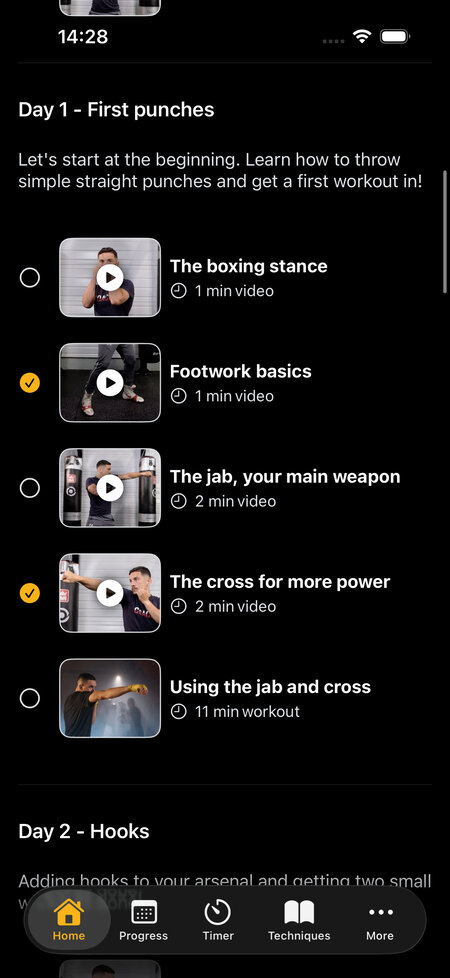
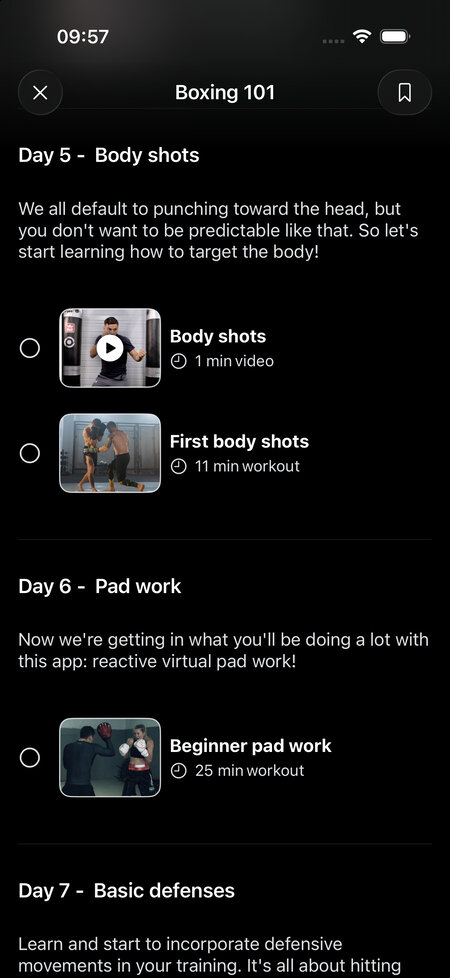
The whole plan is in the app: Boxing 101
This plan follows the Boxing 101 program in the Shadow Boxing App, day for day. Each day pairs short technique videos, filmed with a real coach, with a workout that puts what you just watched to use. The stance, jab, roll and shadow boxing videos linked above are the same ones you’ll find in it.
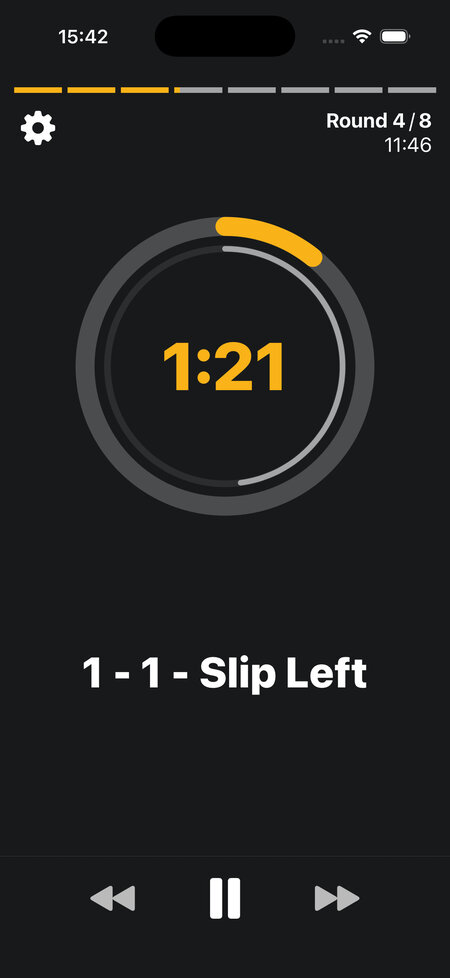
During the workouts, the app calls out punches, defenses and footwork through your earbuds, so the phone can sit on a shelf while you box. From the pad work day onward, that’s what makes the rounds reactive: you hear “1-2, slip” and do it, instead of picking your own combo every time. You can come back to any day and redo it whenever you want, and finishing the program unlocks a little surprise at the end.
Once you’ve finished, Improve your defense is a good next program: it starts with a refresher on blocks, slips and rolls and ends with counters. Or keep it simple and go back over the Boxing 101 days that felt hardest.
The app is free to try, so you can start day 1 tonight.