
Shadow Boxing at Home: Everything You Need to Know
The coffee table is pushed against the wall, your phone is leaning on a bookshelf, and you’re standing in the middle of the living room in a boxing stance. Now what?
That’s the moment where a lot of people stall. In a gym, shadow boxing is easy to slot into: there’s a coach, a clock on the wall and a room full of people who already know what they’re doing. At home you have to build all of that yourself, from the space to the structure to the feedback, whether you’ve never thrown a punch or you’ve boxed for years and can’t get to the gym as often as you’d like. None of it is hard. Most of it just isn’t obvious the first time.

What shadow boxing at home can do for you
Shadow boxing is boxing against an opponent who isn’t there. You stand in your stance, move, punch and defend against someone you picture in front of you. If you want the background on where it comes from and why every boxer does it, our complete guide to shadow boxing covers that. This article is about doing it in your own home, week after week, and getting better at it.
At home, shadow boxing does a lot of jobs at once. It’s where you learn the mechanics of each punch, because nothing hides a sloppy hook when you’re hitting air. It trains your footwork, since there’s no bag to lean on and nothing to stop you drifting off balance. It’s where you build the defensive habits most beginners skip, like moving your head after a combination. And at a decent pace it’s a hard workout: six rounds with constant movement will leave most people drenched.
It also has limits, and it helps to know them up front. You won’t learn what distance feels like against a real person who moves and hits back. You won’t learn what it’s like to land a punch on something solid, and building power is hard when nothing resists the punch. Those come later, from a heavy bag, a partner or a gym. But stance, footwork, punch mechanics, defense and conditioning can all be built in a living room, and that’s most of what a beginner needs.
If you already train at a gym, home rounds do a different job. They’re where you work on the thing your coach keeps pointing out, and they keep your timing sharp in the weeks when work or travel keeps you away from class. Twenty minutes in the living room on the days between classes adds up to a lot of extra rounds over a year.
Setting up your space
How much room you need
Less than you’d expect. A clear area of about 6 by 6 feet lets you step forward, back and to each side, which covers most of what you’ll do. If you can get 8 by 8 feet, you’ll have room to circle and to take two or three steps in a row before you need to turn, and rounds start to feel a lot more like boxing.
Before your first session, do a quick reach test. Stand in the middle of the space in your stance and throw a full jab, a cross and a wide hook. Then take two steps forward, two back, two to each side, and pivot. If your hand or foot touches anything, move it or move yourself. You’ll be more tired and less careful in round five than you are right now, so leave a margin of a foot or so.
Look up as well. Your punches won’t reach a normal 8 foot ceiling, but overhead arm swings during a warmup can catch a ceiling fan or a hanging light, especially if you’re tall. Low basements with exposed ducts deserve a second look. If you plan to add a jump rope later, the rope needs more clearance than your fists do, so swing it slowly a few times before you commit to a full round.
Clear the hazards
Most home training injuries are boring. A toe stubbed on a table leg, an ankle rolled on the edge of a rug, a knuckle clipped on a door frame. Coffee tables and footstools are the worst offenders because they sit right at shin height, so move them out of the space entirely rather than just to its edge.
Rugs that slide need a non-slip pad underneath or need to be rolled up. A rug that shifts during a pivot is a good way to twist a knee. Pick up cables and chargers, and if your phone is on the floor, put it somewhere you won’t step on it. Anything breakable within arm’s reach, like a TV, a lamp or a glass door, should be further away than your longest punch. And if you have a dog or small children, shut the door if you can. A dog wandering between your feet in the middle of a combination is a real hazard, for both of you.
The floor matters more than people think
Footwork is half of shadow boxing, and the floor decides how it feels.
Hardwood, laminate and vinyl are good surfaces. You can pivot smoothly and slide your feet the way boxers do. Carpet is the trickier one. It grips, which feels safe until you pivot on the ball of your foot and the carpet holds your foot in place while your knee keeps turning. If you train on carpet, keep pivots small and consider shoes with a fairly smooth sole so your foot can turn. Tile and concrete are fine for footwork but hard on your joints if your session includes jumping, and cold underfoot in winter.
If you’re going to spend money on one thing, interlocking rubber or EVA foam tiles around 1/2 to 3/4 of an inch thick fix most floor problems at once. They give you grip on smooth floors, a bit of cushioning on hard ones, and they cut the noise for anyone living below you. Skip yoga mats: they’re narrow, they slide around and they bunch up under your feet on the first pivot. Very soft foam isn’t great either, because your ankles end up stabilizing you on every step.
Shoes, socks or barefoot
Barefoot on a clean, smooth floor works well for a lot of people. You feel the floor, your feet get stronger, and there’s nothing to buy. The downsides are stubbed toes and sore soles after long sessions on a hard surface.
If you prefer shoes, pick something flat and light with a thin sole. Boxing shoes are ideal but not required; flat training shoes or court shoes do the job. Running shoes are the ones to avoid. Their thick, soft heels are built for going forward in a straight line, and the extra height makes it easier to roll an ankle on a lateral step.
Socks on a smooth floor are the one option that’s clearly bad. Every pivot turns into a slide, and every quick step back becomes a gamble.
Mirror, phone and sound
A mirror is useful but not essential. It’s the fastest way to check your guard, the angle of your chin and whether your rear hand stays home when you jab. A cheap full-length mirror leaned against the wall is plenty. Use it for a round or two to check one specific thing, then turn away from it. If you watch yourself for the whole session, your head stops moving and your feet stay planted at whatever spot gives you the best view.
The same goes for your phone. Put it somewhere stable and out of your movement area, then plan not to look at it during rounds. That’s why the Shadow Boxing App calls out combos with audio and hides the video once a round starts: your eyes stay on the imaginary opponent and the phone can sit on a shelf behind you. If you don’t own a mirror, the app can turn on the front camera during a workout so you can check your form, or record a round so you can watch it afterwards.
For sound, a speaker works fine if you’re alone. Earbuds are better if someone else is home or asleep, and they keep callouts clear over music. Pick a pair that stays in when you slip and roll; earbuds that fall out on the first bit of head movement will have you stopping every thirty seconds.
Air and water
A small room heats up fast once you start moving. Open a window or run a fan, and keep a water bottle and a towel just outside your training area. In winter the opposite problem shows up: a cold room means cold shoulders and wrists, so take your warmup seriously before you start punching fast.
What gear you actually need
None. You can shadow box in whatever you’re wearing, with no equipment at all, and that’s how most people should start. Beyond that, here’s how the gear breaks down:
- Worth having from day one: a timer (your phone is enough), water and a towel.
- Nice to have: flat shoes if your floor calls for them, earbuds that stay in, a mirror.
- Optional: hand wraps or light gloves. Neither protects you from anything when you’re punching air, but some people like the feel, and gloves of 12 to 16 oz add a little shoulder endurance work.
- Skip: dumbbells in your hands while you punch. The weight pulls your arm down instead of resisting the punch, it changes your mechanics, and it loads your elbows and shoulders at full extension. If you want resistance, do strength work between rounds instead.
Once shadow boxing is a habit, the next pieces of equipment that make sense at home are a jump rope, a heavy bag and a speed ladder. We cover what each one adds in this guide to boxing equipment at home.
Get the stance and guard right first
Everything builds on your stance, and at home nobody is there to fix it, so spend a few minutes on it before you think about combinations.
Stand with your feet a little wider than your shoulders, one foot in front of the other. If you’re right-handed, your left foot usually leads (orthodox); if you’re left-handed, it’s usually your right (southpaw). Turn your body slightly sideways so you present a smaller target, lift your rear heel a little and keep your knees soft. Your weight sits between your feet, not back on your heels.
Your hands go up by your cheekbones, elbows close to your ribs, chin tucked so you’re looking out from under your eyebrows. This is home base. Every punch starts here and comes back here, and at any point in a round you should be able to freeze and find yourself in this exact position.
If you’ve boxed before, read this as a checklist rather than a lesson. When you train alone, the stance is usually the first thing to drift: your feet creep closer together, your hips square up and your rear hand slides away from your chin as the rounds go on.
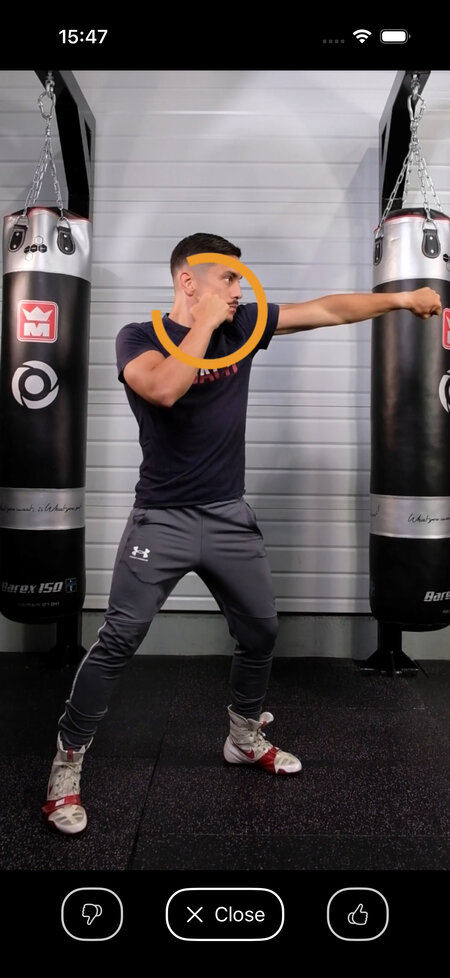
If you’re starting from zero, learn the punches one at a time before you string them together. Our guide on how to throw every basic punch breaks down the jab, cross, hooks and uppercuts in detail.
How to shadow box well
Anyone can wave their arms around for three minutes. What makes a round useful is a handful of habits. Beginners can start practicing all of them in their first session, and experienced boxers tend to let a few of them slip when nobody is watching.
Picture someone specific
Before the round starts, decide who you’re boxing. How tall are they? Orthodox or southpaw? Do they walk forward or stay on the outside and jab? Then put them in the room at a real distance, close enough that your jab would just reach their chin at full extension.
That opponent is what turns random punches into boxing. They decide where your punches go, when you need to move, and what you need to defend against. If you couldn’t point to where they are at any moment in the round, you’ve stopped shadow boxing and started doing cardio.
If you spar, use real people. Box the partner who keeps catching you with the same right hand, or the one who walks you down every round, and practice what you’d like to do differently next time.
Move your feet between punches
The most common habit at home is standing in one spot and punching, partly because the room feels small. You don’t need much space to keep moving. Step in with the jab, step out after the combination, take a small step to the side, pivot. Keep the steps short and never cross your feet. In a 6 by 6 foot area you can move for an entire round if each step is a few inches rather than a stride.
Punch at the right speed, and don’t lock your elbows
Most rounds should be at a pace where your form holds up, around 60 to 70 percent of your top speed. Speed up once the technique stays clean, not before.
Punching air comes with one specific risk: there’s nothing to stop your arm. If you throw at full power and snap your elbow straight every time, the joint absorbs the force, and after a few weeks of that, elbow pain is a common result. Extend almost all the way, then turn the punch around just before the elbow locks.
If you’ve been boxing for a while, mix in short bursts at full speed to work on hand speed. The elbow rule matters even more then.
Bring your hands back
A punch isn’t finished until your hand is back at your face. Without a target it’s easy to leave the jab hanging out there, or let the rear hand drop while you hook. Make the return as sharp as the punch itself.
Defend in every round
Nothing comes back at you at home, so most people stop defending altogether. Add it on purpose. After a combination, slip or roll the counter you imagine coming back, or step out of range. A simple rule like “every combination ends with a slip or a step out” changes your habits a lot over a few months.
Breathe out with each punch
Use a short, sharp exhale with every punch. Holding your breath through combinations is one of the main reasons beginners are exhausted by the second round, and it’s hard to notice when you’re training alone.
How to structure a session
Boxers train in rounds, and you should too. Rounds give you a pace to aim for, a rest to recover in and a clear end point, which matters a lot when you’re training alone and nobody is going to tell you when you’re done. Use a timer for every session, even the short ones.
A beginner session can be four rounds of 2 minutes with a minute of rest between them. As your fitness improves, move up to six to eight rounds of 3 minutes. If you already train regularly, 8 to 12 rounds makes a solid session, and you can cut the rest to 30 or 45 seconds when you want more conditioning. A complete session looks something like this:
- Warmup, 5 to 10 minutes. Mobility for the neck, shoulders, hips and ankles, something to raise your heart rate, then a round of very light shadow boxing. Here’s a simple warmup routine that fits in any living room.
- Technique round. One punch or one short combination, done slowly and repeated with small corrections each time.
- Combination rounds. Longer sequences, with footwork between them and a defensive move at the end of each one.
- Defense round. Mostly slips, rolls, blocks and steps back, each followed by a counter.
- A harder round. Everything mixed together at a higher pace. This is where your guard drops, so watch for it.
- Strength and cardio (optional). Squats, push-ups, lunges or planks between boxing rounds if you want more conditioning.
- Cooldown, about 5 minutes. Slow movement, then stretching while your breathing settles.
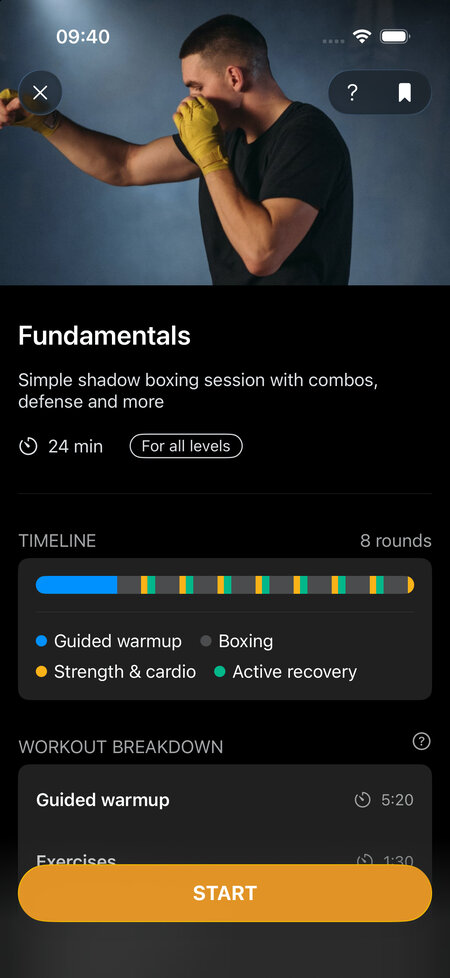
For a closer look at what to focus on in each round, see how to structure a shadow boxing home workout. If you use the app, the workouts follow the same logic: a guided warmup, then boxing rounds mixed with strength and cardio and short active recovery rounds.
How often to train
Three sessions a week is a good starting point. Shadow boxing is low impact compared to running or bag work, so some people train four or five days a week, but your shoulders and elbows still need time to adapt, especially in the first month. A 20 to 30 minute session three times a week will take you further than an hour-long session you do once and then avoid for ten days.
If you also train at a gym, use home sessions for the lighter, technical days between classes. A few slow rounds on whatever gave you trouble last time will do more for you than another hard session that leaves you flat for the next class.
The time of day matters less than picking a slot you won’t lose. For many people that’s first thing in the morning, before work and everything else gets a say. For others it’s right after work, before they sit down. Whichever it is, try to keep it the same so the session becomes part of the day instead of a decision you have to make every time.
Keeping the noise down
Shadow boxing itself is quiet. You’re punching air. The noise comes from your feet and from everything around the boxing: bouncing on your toes, heavy steps on pivots, jumping jacks, burpees, jump rope and music. In an apartment, the people below you hear thumps far more than voices.
The biggest fix is to stay light without bouncing. Plenty of beginners copy the constant bounce they’ve seen in fights; on a wooden floor that sounds like someone jogging in place for half an hour, and it burns energy you’ll want in the last round. Keep your rear heel slightly raised and move with small, smooth steps. Land each step softly instead of stamping into it.
When it’s early or late, swap high-impact conditioning for quieter options. Squats instead of jump squats, slow mountain climbers instead of burpees, lunges and planks instead of jumping jacks. Jump rope is the loudest thing you can do indoors, so save it for when the neighbors are out, or take it outside. Rubber or foam tiles help a lot if you train often, and earbuds take care of the music.
In the app, you can drop the intensity to Light or Moderate on early mornings, and if a workout includes strength and cardio rounds you don’t want at 6 AM, open it in the workout editor and remove them.
If you live above someone, ask whether they hear you. Most of the time they don’t, and when they do, knowing which hour bothers them is better than guessing.
Training without a coach
What you miss most at home is someone watching you. In a gym, a coach would notice your jab dropping in the second week. At home, the same habit can run for months before you spot it. A few things close most of that gap.
Learn each technique before you drill it
You won’t stumble onto a good hook by repeating a bad one. Before you drill a punch or a defense in rounds, watch a good tutorial and practice it slowly a few times. The same goes for experienced boxers adding something new, like a check hook or shifting stances mid-combination: learn it slowly first, then put it in rounds. In the app, every technique has a tutorial video filmed with a real coach, from the jab and the basic slip up to advanced techniques like the check hook, shifting and the L step.
Record yourself
A phone propped against the wall is the closest thing you have to a coach’s eye. Record a round every couple of weeks and watch it back. You’ll see things you can’t feel while you’re doing them: your chin lifting when you’re tired, your rear hand dropping as you jab, your feet ending up square after a combination. Comparing with a video from a month earlier also shows you the progress, which helps on the weeks when it feels like nothing is changing.
Let something else call the combinations
Alone, you tend to throw the same few combinations you like, at the same rhythm, every round. It feels productive, but in a real exchange you don’t get to choose the timing. When someone else calls the combinations, you have to react, and that’s a different skill from repeating a sequence you planned. A training partner can do it. So can the Shadow Boxing App: it calls out punches, defenses and footwork in real time and changes the callouts every session, so you’re answering instead of choosing and you can’t settle into a pattern.
Pick one focus per round
Before each round, pick one thing to fix. “Hands back to my face after every punch.” “Step out after every combination.” Keep it small enough to track for the full three minutes. Trying to correct everything at once usually means nothing sticks, while one small fix per round adds up quickly over a few weeks.
Common mistakes when shadow boxing at home
Some shadow boxing mistakes happen anywhere. These ones are specific to training at home:
- Facing the same wall all session. You tend to box toward the TV or the mirror. A real opponent circles, so turn and circle with them.
- Letting the rest periods drift. Without a timer, one minute of rest becomes four minutes of checking messages. Time the rests as strictly as the rounds.
- Leaving notifications on. One message in the middle of a round and your focus is gone. Turn on Do Not Disturb before you start.
- Skipping the warmup because it’s “only shadow boxing.” Fast punches on cold shoulders are a common way to tweak something in the first round.
- Doing the same session every time. After a few weeks your body adapts and your boxing stops improving. Change the focus, the round length or the intensity every week or two.
- Going all out every day. It’s tempting when there’s no coach to slow you down, but sore elbows and shoulders end more home routines than boredom does.
Using an app at home
Most of what makes home training hard comes down to things a coach normally handles: deciding what to work on, keeping time, calling combinations and pushing you to the next level once you’re ready. The Shadow Boxing App is built to cover that for people training on their own.
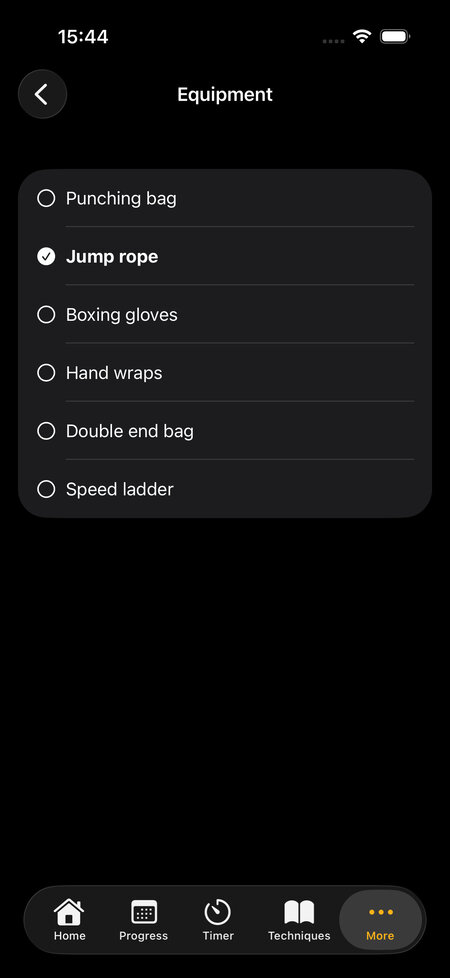
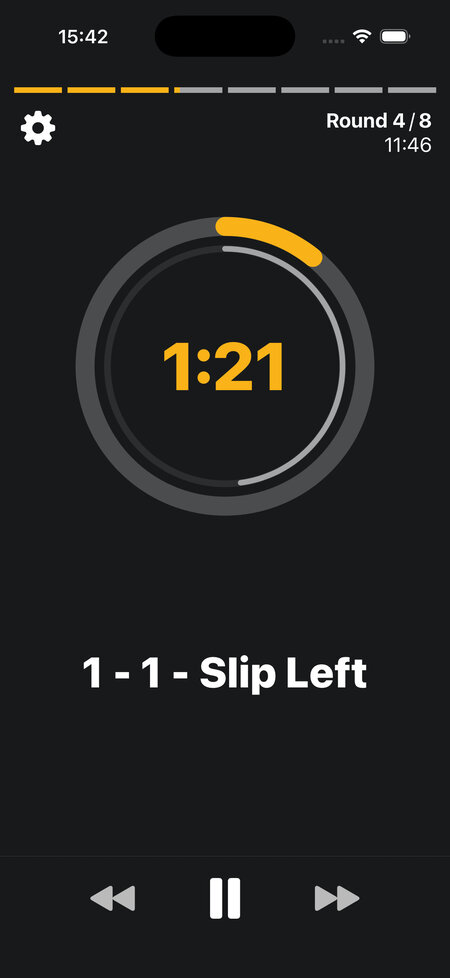
When you set it up, you tell it what equipment you have. If the answer is none, that’s fine: every workout can be done with no gear at all, and if you get a heavy bag later, the app starts recommending workouts and programs built for it. During a session it runs the timer, takes you through a guided warmup and calls out combinations, defenses and footwork through your earbuds, so the phone stays on the shelf and your attention stays on the opponent in front of you.
For days when you don’t want to choose a workout, Quick Start asks how much time you have, how technical and how hard you want it to be, and how much variety you want, then builds a session from your answers. Set the technique to Simple to focus on fitness without thinking too much, or to Very Technical if you want harder exercises. The app also asks for your boxing level when you set it up and uses it to pick recommendations that fit you. The app is free to try, and the free workouts are enough to find out whether training this way works for you.
How to progress over the months
If you’re just starting
Your first couple of sessions are for the basics: stance, guard, jab, cross and moving your feet between punches. Bring in defense right away too. Even a simple step back or slip after each 1-2 makes defending a habit from day one, and it’s much harder to add later once you’re used to standing still after every combination. Keep the rounds and the sessions short.
After a couple of sessions, add hooks and uppercuts, along with more defensive moves like rolls and blocks. Over the following weeks, build longer combinations, keep defense in every round and move up to 3 minute rounds.
If you want a more structured progression
Working out what to add next, and when, is hard on your own. Most people either rush ahead or stay on the 1-2 for months. If you’d rather follow a plan, the Boxing 101 program in the Shadow Boxing App lays one out for you. It starts with the jab and cross, adds hooks and uppercuts over the next two days, and then works through body shots, virtual pad work, the main defenses and combinations, with a review workout and a HIIT session at the end. Each day pairs a few short technique videos with a workout that puts what you just watched to use, so a round never asks you for something you haven’t learned yet.
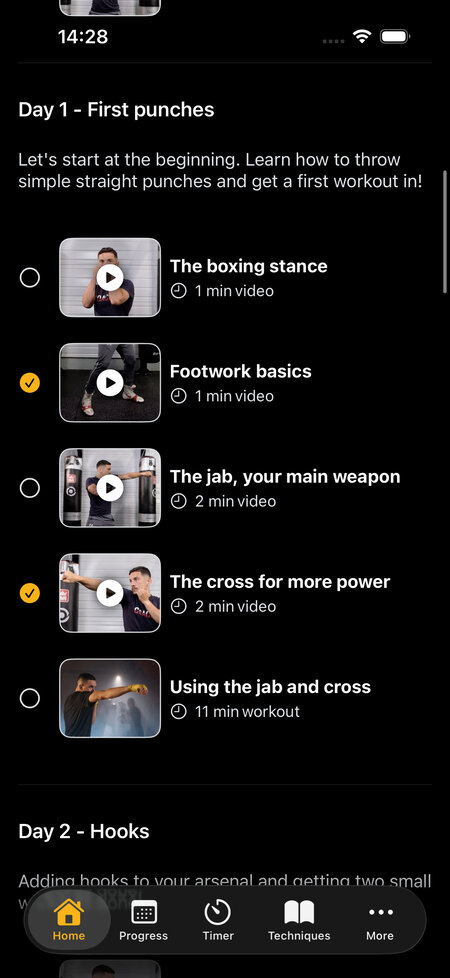
If twelve days sounds like a lot, Start Boxing in 30 Minutes is a shorter way in: a few punches, basic footwork and two short workouts, all in under half an hour.
If you already have some experience
Once you know the basics, progress comes from more rounds, higher intensity, more technical work and specific scenarios: boxing a southpaw, working off the back foot, fighting someone who keeps walking you down. Pick one weakness at a time and give it a few weeks of focus instead of running the same well-rounded session forever.
The app has programs for this stage too. Improve your defense starts with a refresher on blocks, slips and rolls, moves on to more technical exercises and finishes with counters. The A week of boxing programs lay out a full training week at beginner, intermediate or advanced level, mixing offense, defense, footwork and cardio with lighter days for recovery. And if you already box and only need to learn how the app calls things out, the short Discover the app program gets you used to its numbering system.
Signs that it’s working
Whatever your level, a few things tell you the home rounds are paying off: your guard is still up in the last round, your feet return to your stance without you thinking about it, you can hold a steady pace for 3 minutes, and callouts you used to fumble now come out clean.
At some point you’ll want more than a living room can offer. A heavy bag adds resistance and lets you work on power. A gym adds a coach, partners and eventually sparring. Shadow boxing at home doesn’t replace those, but it makes the transition easier: people who’ve put in a few months of good rounds at home tend to walk into a gym already knowing how to stand, move and punch, and they get much more out of their first classes. If you already train at a gym, the home rounds are what make the gym sessions count, because you show up having already worked on what your coach told you last week.
For now, push the coffee table back, pick your corner of the room and do two rounds tonight.