
The Punching Bag Workouts Got a Big Update
The punching bag workouts in the Shadow Boxing App just got their biggest update since they were introduced!
Despite the name, the app is not only for shadow boxing: a good chunk of our users train with it on a heavy bag, and there is a whole section of workouts built for that. Every bag exercise now scales properly to your fitness and technical level, the coach tells you exactly what to throw instead of vague “keep punching” cues, and there are two new workouts, one of them built around inside fighting.
Here is what changed and why.

Why we reworked them
The bag exercises were some of the earliest content in the app, and they showed their age. For the past few weeks we trained with them ourselves, on a real heavy bag, every session, and took notes on everything that felt off. Then we went through all the recent feedback and reviews mentioning bag work. The same complaints came up on both sides.
The biggest one: the instructions were too vague. A cue like “non-stop punches” for 30 seconds sounds fine on paper. On the bag it leaves you guessing. Non-stop what? Jabs? Full combos? Should these be light or hard? Most people default to flailing 1-2s at half speed and losing form, which is the opposite of what a coach would want.
The second one: the exercises did not adapt enough. A beginner and an experienced boxer got roughly the same round, with the same rhythm and the same recovery windows. That is too easy for one and too hard for the other.
Clearer instructions on every bag round
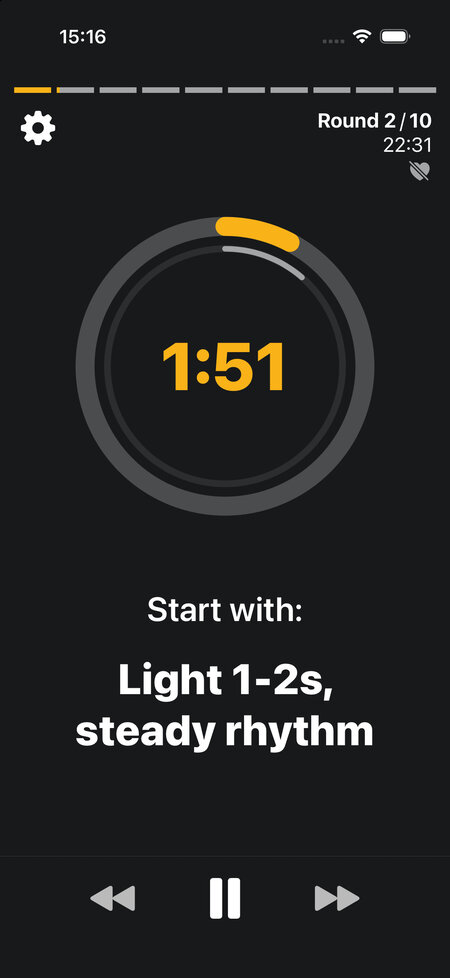
Every bag exercise now tells you what to do in concrete terms. The generic “non-stop punches” cue is gone. In its place, the light phases of each round pick a specific job: light 1-2s at a steady rhythm, light jabs with footwork, light body hooks, footwork with jabs and feints, and so on. You always know which punches to throw and at what effort.
The power phases got the same treatment. When the coach calls “explosive punches”, the app follows up with the exact combo to throw, and keeps feeding you new ones for the whole phase. The recovery phases are explicit too, with cues like “slow down, light jabs and feints” rather than a plain “rest” that most people interpret as standing still with hands down.
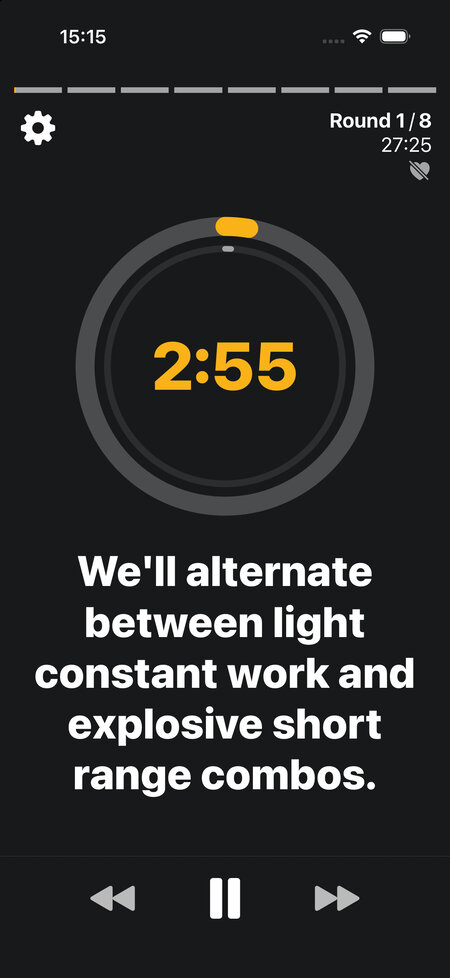
We also cleaned up how the exercises introduce themselves. Each one now opens with a short explanation of the pattern you are about to run, for instance “we’ll alternate between light work and throwing a combo with power”, then the first cue. You are not surprised mid-round by a phase you did not know was coming.
Scaling to your fitness and technical level
This is the change we are happiest with. The bag exercises now use your intensity setting and your boxing level to shape the round, not only the round length.
On the fitness side, intensity changes the length of the explosive phases and the length of the recovery that follows. At the light setting, power bursts are short and recovery is long. At max effort, the bursts stretch out and recovery shrinks to almost nothing. The same applies to how fast new combos are called during a power phase: at the light setting you get a new combo every eight seconds or so, at max effort every three.
On the technical side, your boxing level decides which bag exercises end up in your workouts and how demanding they are. Beginners get rounds built on short, simple sequences they can throw cleanly with power. More experienced boxers get the exercises that mix defense, level changes, and short-range work into the bursts. The defense-based bag rounds also grow the follow-up combo after each slip or roll once you are past the light setting, and the reflex rounds tighten the gap between signals, which is where they start to feel like real reaction work.
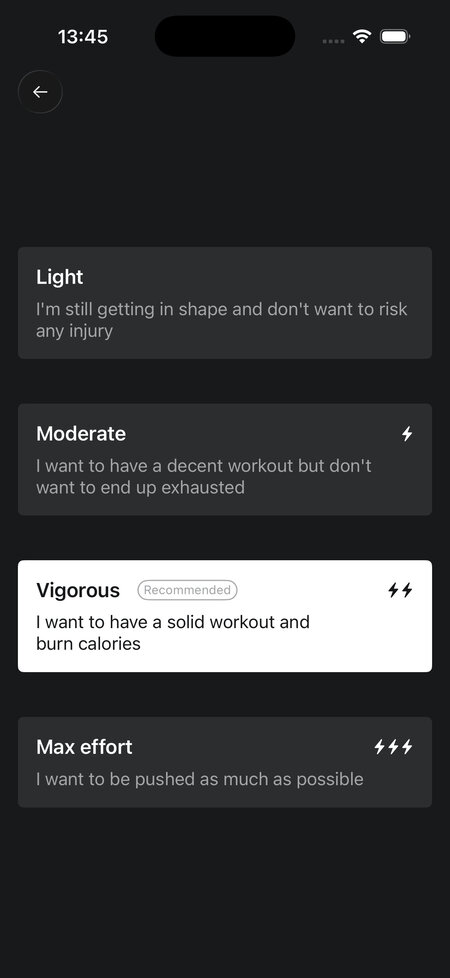
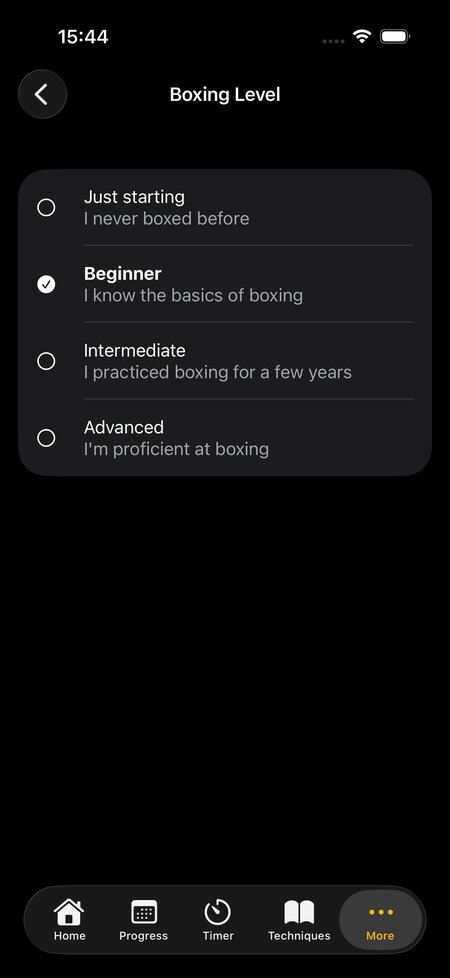
If you have not set your level and intensity in a while, this is a good time to check them. They matter a lot more on the bag now than they used to. The quick start punching bag workout picks up these settings automatically, so it is the fastest way to feel the difference.
New: Inside Fighting on the bag
Most bag work happens at mid range: you stand at arm’s length and throw straight punches and hooks. Fighting on the inside is a different skill. You are chest to chest, there is no room for a jab, and everything is short hooks, uppercuts, and body shots, with your head moving between combos so you are not a stationary target.
The new Inside Fighting (bag) exercise trains exactly that. The round alternates between light constant work and explosive short-range combos. When the coach tells you to move closer to the bag and punch with power, you step in until you are almost touching it and throw the called combo: things like a lead hook to the body followed by a rear hook upstairs, or a roll under an imaginary punch straight into a pair of hooks. Every combo includes a level change or a body shot, because that is what inside fighting is made of. Then you back off to light work, recover, and go again.
It is harder than it sounds. Generating power with no wind-up, six inches from the bag, takes hip rotation and leg drive that most people never train. The first few rounds will feel awkward and your shots will feel weak. That is the point. There is a dedicated workout built around this exercise, also called Inside Fighting (bag), with level changes and powerful body shots throughout. If you have never worked short range before, the tutorial on managing distances in the techniques catalogue is a good primer before you try it, and if you are new to the bag altogether, start with our guide on getting started with heavy bag training first.
New: Bag Burst Defense
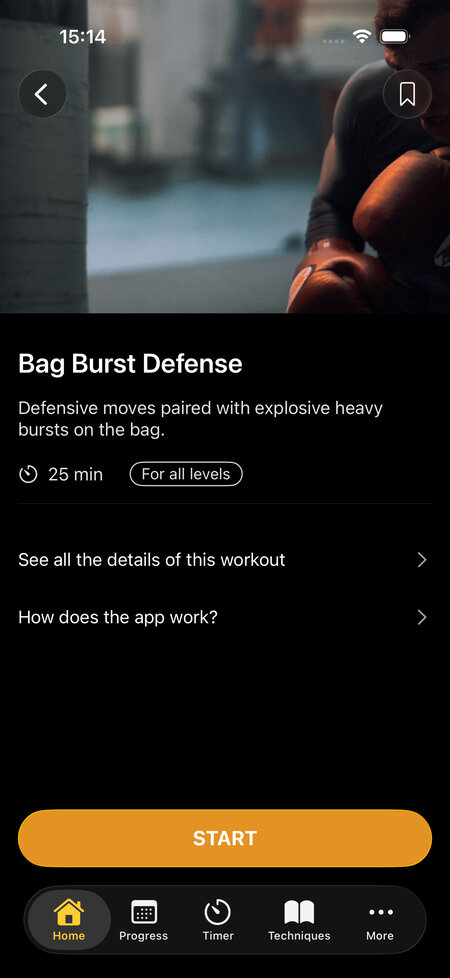
The second new workout, Bag Burst Defense, pairs defensive moves with explosive bursts on the bag.
The round goes between light freestyle and hard combos, and after every combo you have to defend: slip, roll, or step back, depending on what the coach picked for the round. It fixes a bad habit that heavy bags encourage, which is admiring your combo instead of getting out of the way afterwards. The bag never punches back, so the app has to remind you that an opponent would.
What this means for existing bag workouts
You do not need to do anything. All the existing bag workouts, the ones in the bag workouts section and the ones generated by quick start, use the updated exercises automatically. If a workout felt too easy or too confusing before, give it another go with your level and intensity set correctly.
We are still collecting feedback on these, especially on the inside fighting exercise, which is new territory for the app. If something feels wrong on your bag, tell us through the app and we will keep adjusting.