
Why the Video Disappears Once the Round Starts
We put a lot of work into the tutorial videos in the Shadow Boxing App. Real coaches, multiple angles, the small details that make a punch land right. So people are sometimes surprised that once a workout actually starts, most of the time there is no video on the screen at all. Just the timer, the callout, and a voice telling you what to throw. That is on purpose, and this article explains the thinking behind it.
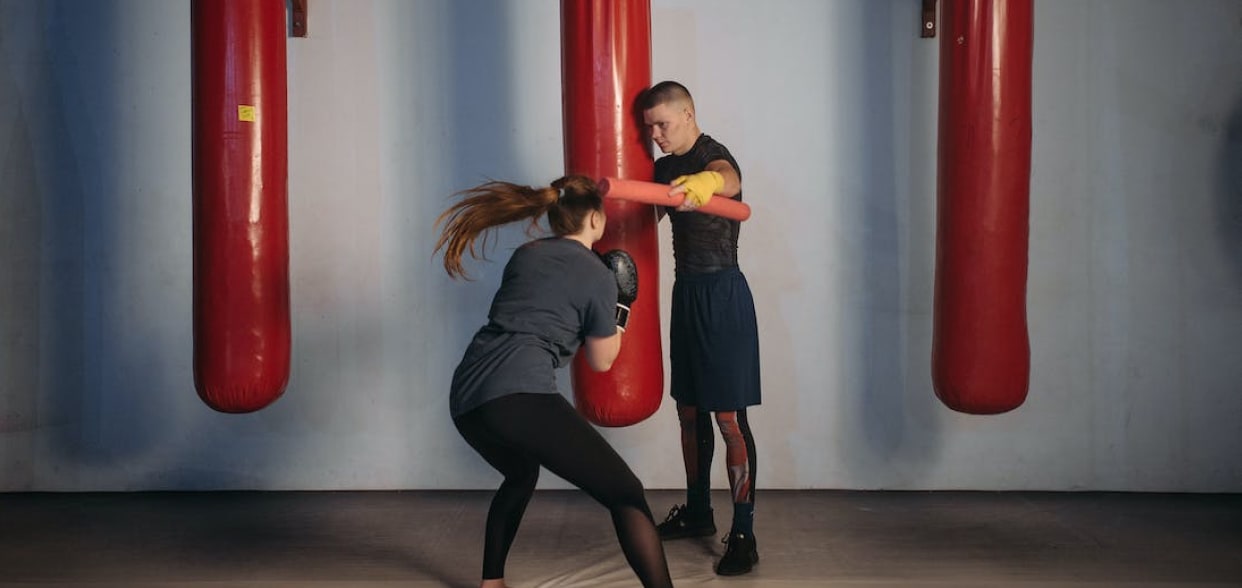
Learn first, then put the phone down
Here is how a technique moves through the app. You open its page and watch the tutorial. You practice it a few times in front of the phone, maybe rewind the part where the coach turns the hip, and try it again until it feels close. Then you start a workout that uses it.
At that point the video goes away. The app calls out “2”, or “Slip Left - 2”, and you do it. If you blank on what a number means, you pause the workout and the help section is right there, with every technique from the current round one tap away. You look, you remember, you tap play, and you are back in.
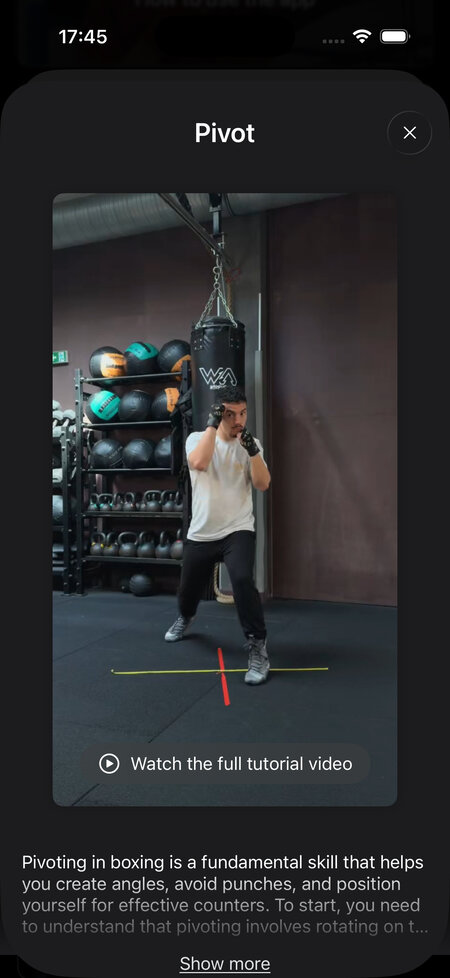
The split is simple. Watching is how you learn a movement. Doing it under a little pressure, without a reference in front of you, is how you actually own it. We already wrote about how the app mixes audio, text and video to call out combos; this piece is about why the video is the one channel we deliberately take away when the round starts.
What a screen does to your boxing
Try this the next time you shadow box: put a video on and follow along. Notice what your body does. Your chin lifts so your eyes can find the screen. Your head stops moving, because a moving head loses the picture. Your feet settle into one spot, at whatever distance lets you see the phone, and they stay there. Your lead hand drifts down a little, because you are copying rather than guarding.
None of that is boxing. Every single thing a coach would yell at you about is a direct result of looking at a screen. And the more you tune into the video, the more you turn into a mirror of the person on it, half a beat late, with your weight sitting wrong.
The point of a round is to react. A sound arrives and your body answers before you have consciously processed it. That is the same skill you need on the mitts, on the bag, and eventually in sparring, and the only way to build it is to train with your eyes forward and your attention on the imaginary opponent, not on a rectangle of glass 6 feet away. Some people prop the phone on a shelf behind them and never look at it for the whole session. That is close to the ideal.
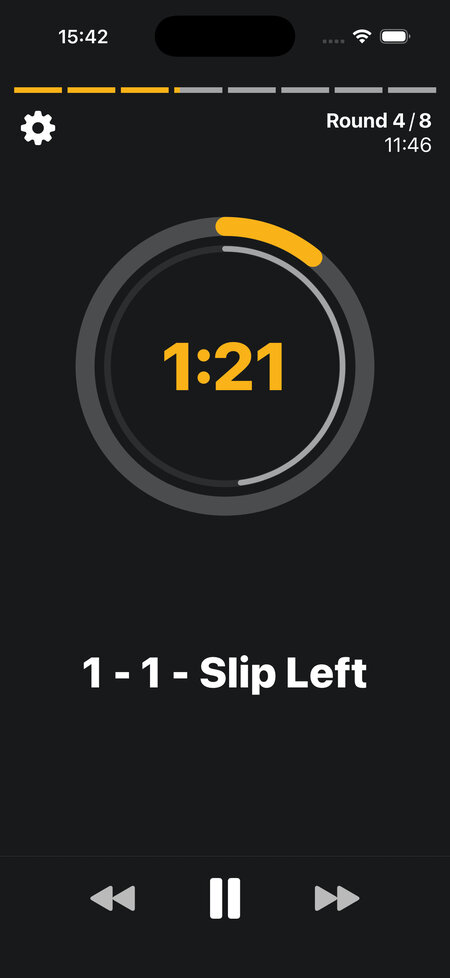
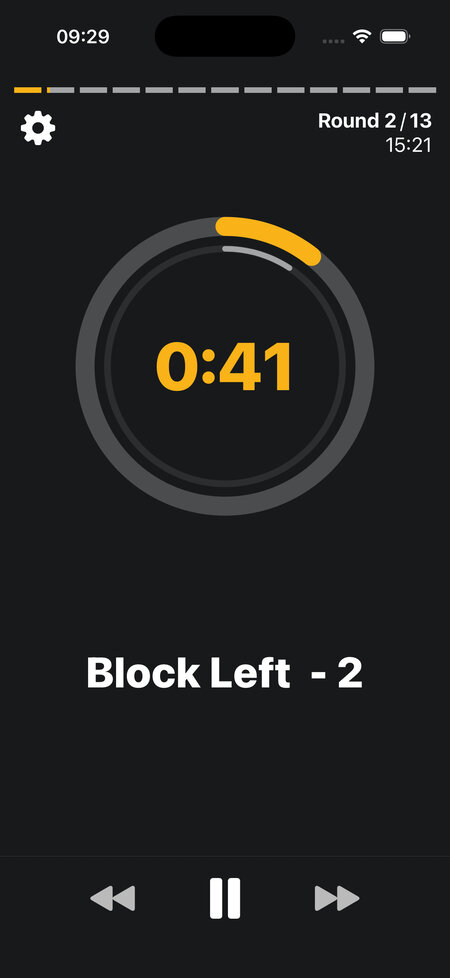
This is also why the audio cues come at you the way they do. In a reactive exercise the callouts are timed to be a little uncomfortable. You hear “1 - 1 - Slip” and there is no time to check anything, so you throw. Miss one and the next one is already coming. That pressure is the feature. We covered the reasoning in more depth in the article on staying in the moment: boxing keeps you present because something is always about to happen, and an app that lets you stare at a screen throws that away.
Short loops when you need a reminder
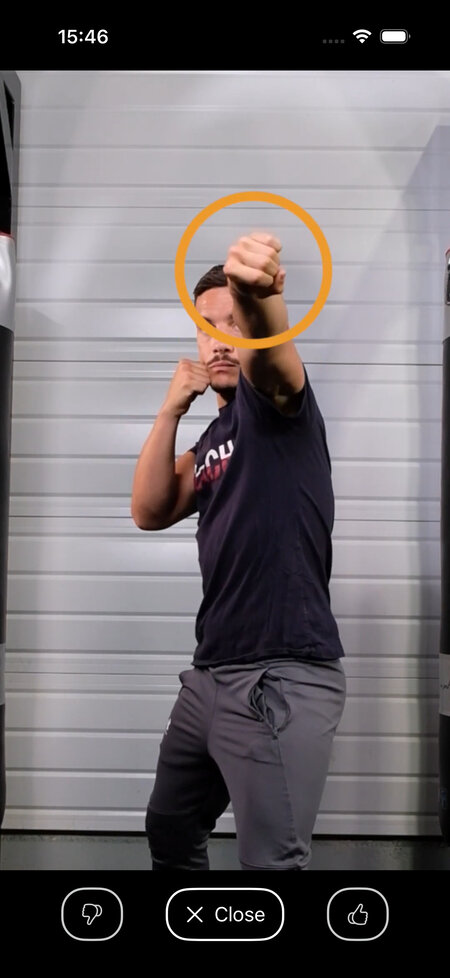
Taking the video out of the round does not mean leaving you stranded. Every technique page in the app has a short looping preview of the move, a few seconds of the coach doing it, right at the top. It plays without sound and without you having to press anything. When you have forgotten what a check hook looks like, that loop is enough to jog your memory in about two seconds, and you can get back to the workout.
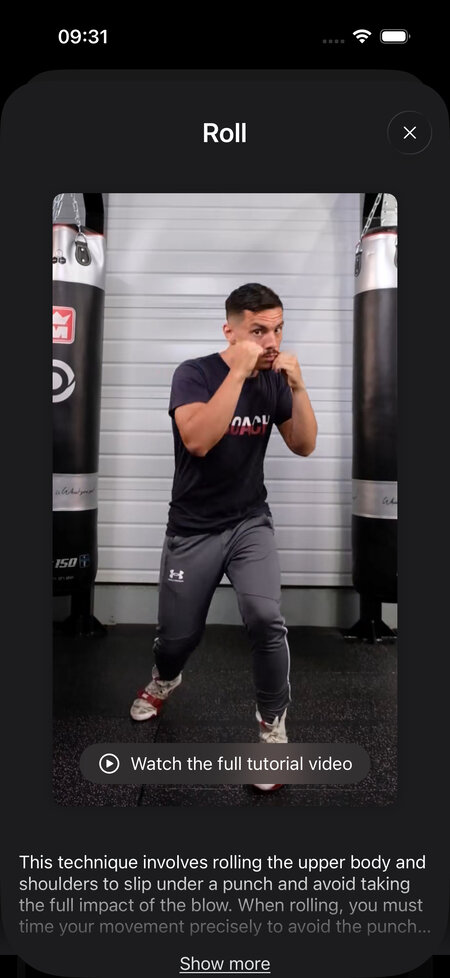
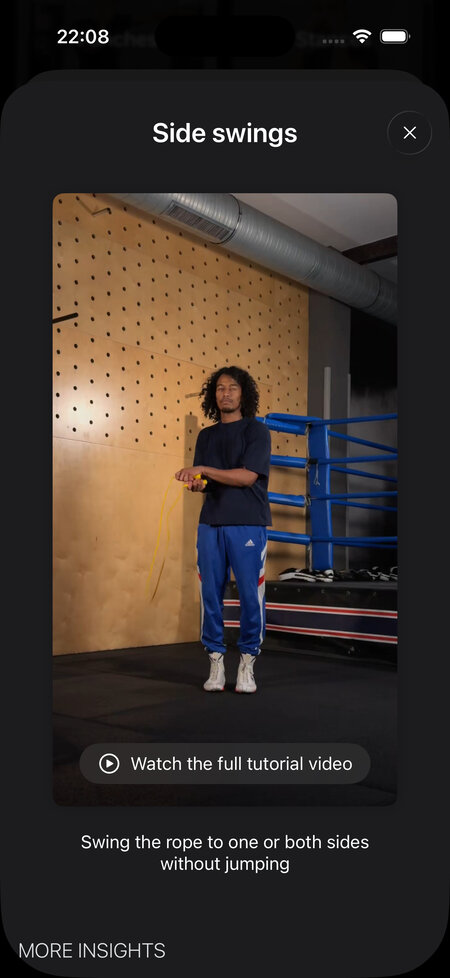
Under the loop sits the button for the full tutorial video, for the times when a quick reminder is not enough and you want the whole breakdown again. Both are there when you pause. Neither one is there while the timer runs. We think that is the right balance: instant help on demand, zero distraction by default.
Make the workout your own
There is a second reason we do not show you every movement on screen, and it has nothing to do with attention. No two boxers box the same. Two people can throw the exact same combo and look nothing alike, because one of them steps in on the jab, the other slips off the cross, one sits down on the hook, the other stays light and pivots out. That variation is the point. It is where your style comes from.
If the app played a video of a coach doing “1 - 2 - 3” and you copied it frame by frame, you would learn that coach’s 1-2-3. You would learn to stand still while throwing it, because that is what the demonstration shows. You would get a lot of reps in, and you would look like someone following along in a fitness class, not someone boxing.
Instead, when the app calls “1 - 2 - 3”, the combo is the instruction and everything else is yours. Where your feet are when you start it, whether your head moves between the punches, how you get out afterwards. We have exercises dedicated to footwork and to head movement, so those skills get worked on directly, but in a normal round we do not spell out every action for you. A boxing gym coach does not either. They call the combo, and they expect you to be moving before, during, and after it, because that is what boxing is.
This is a real difference from most workout apps, where the whole session is one movement repeated for a set of reps, with a demonstration on loop so you can match it. That format is great for a squat. It is a poor fit for a sport where standing still and watching is the one thing you must never do. We wrote about a related idea in the article on punch count: the number of punches you throw is a bad measure of a round, and copying a video for reps pushes you toward exactly that mindset.
When we do keep the coach on screen
There are exceptions, and they follow one rule: the demonstration stays on screen when watching helps more than it hurts.
Calisthenics is the clearest case. During a burpee or a set of mountain climbers you are not reacting to anything. There is no opponent, nothing to slip, and looking at a screen costs you nothing. Seeing the coach doing the movement next to your timer helps you match the pace and the form, so we leave it there. The same goes for the guided warmup and the mobility exercises, where the whole exercise is “move like this for 40 seconds”.
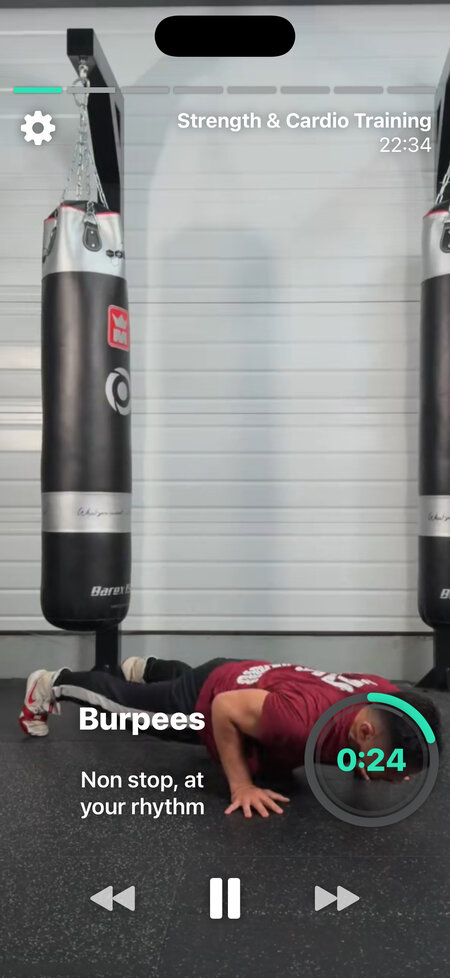
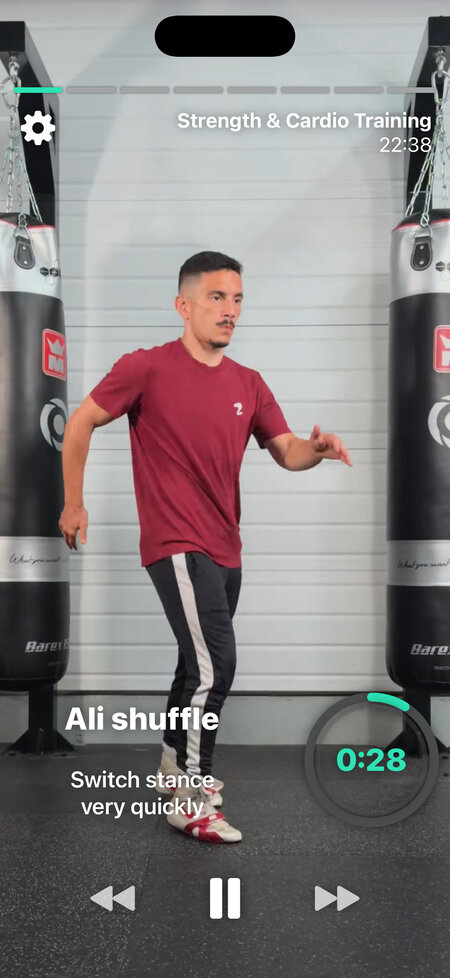
Some drills fall in the same category. Jump rope exercises that ask you to lay the rope on the floor and step over it, speed ladder patterns, footwork drills like the Ali shuffle where you repeat the same movement for a whole interval. When you are going to stay on one move long enough for the picture to matter, the coach stays on screen. Beginner exercises that teach a combo step by step also show the movement, because at that stage you are still learning what the numbers mean and seeing it helps more than any callout could.
The moment an exercise becomes reactive, the video goes away again. A dodge round, pad work, counters, a plain round of combos: eyes forward, hands up, listen.
Built to feel like a boxing gym session
Everything above comes down to one idea. We want a session in the app to feel like a session in a boxing gym, where you learn a move by watching and asking, then drill it with a coach calling things out and correcting you, and the rest is up to you. The tutorials are there for the learning part, filmed with people who actually coach. The loops are there for the quick reminder. The audio cues run the round. And the space between the callouts is where you box.
If you have been training with a video in front of you, try one workout with the phone out of your eyeline. The first round feels strange. By the third, your head is moving and your feet are doing something, and you will probably not want to go back.