
Can You Really Learn Boxing With an App?
Short answer: yes, you can learn boxing with an app, and a good one will take you a lot further than most people expect. You will not walk out a pro from your living room, but you can build a real jab, learn how to move your feet, and understand defense well enough to hold your own. The trick is knowing what an app does well, where it falls short, and how to pair it with other things so the gaps close.
What an app can actually teach you
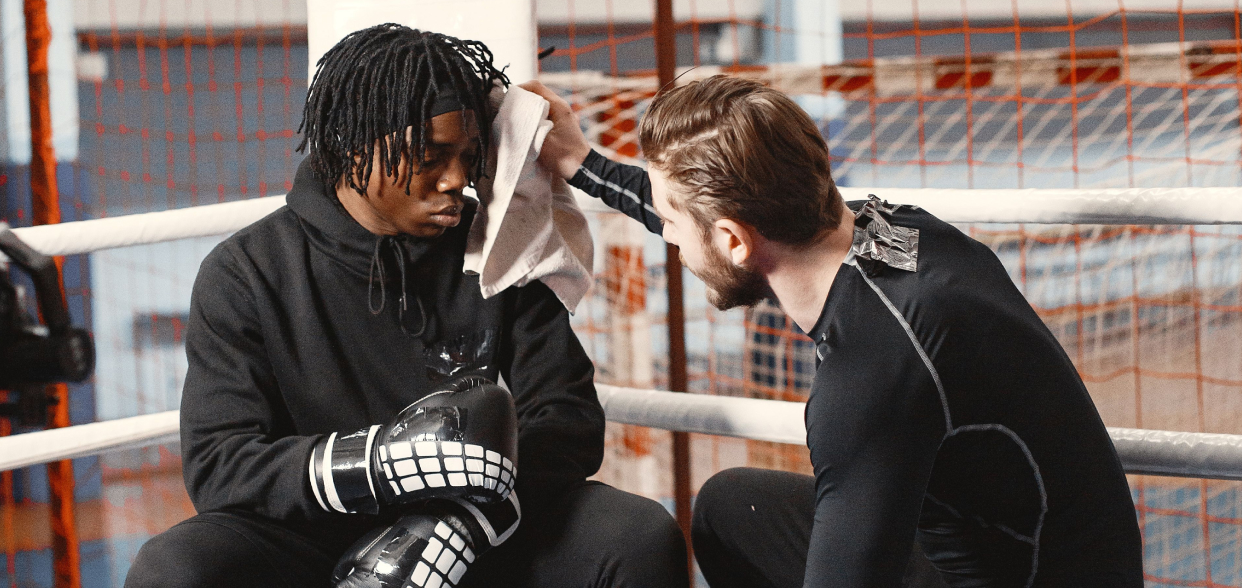
The worry people have is that boxing is too physical to learn off a screen. There is some truth to that, but far less than you would think. The fundamentals of boxing are teachable: the six punches, your stance, how to shift your weight, slips and rolls, footwork. None of that requires a person standing in front of you to get started. It requires clear instruction, repetition, and something telling you when you are doing it wrong.
That is exactly what the Shadow Boxing App is built around. Instead of a random pile of drills, you get structured programs that teach in order. The Boxing 101 program, for example, walks a complete beginner through the six punches and the main defensive movements over about 11 days, mixing short tutorial videos with actual workouts so you are learning a move and then throwing it in the same session.
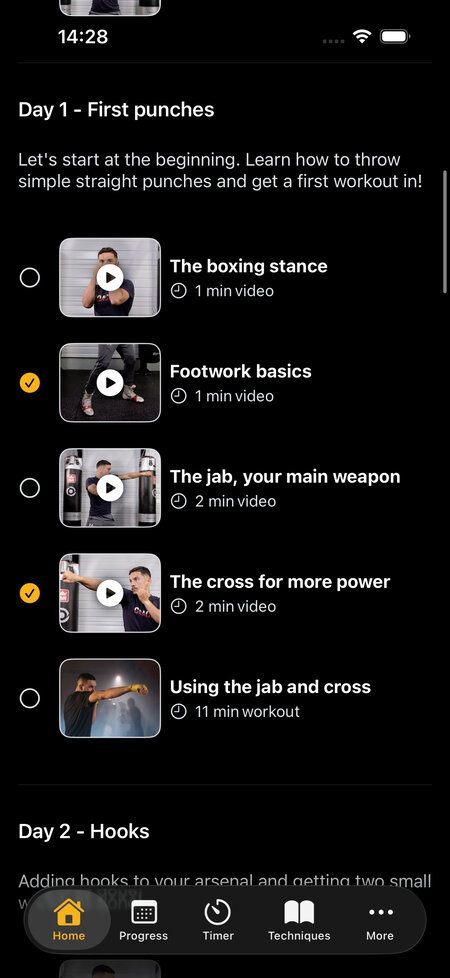
Programs matter more than most beginners realize. Watching a jab video once teaches you almost nothing. Throwing that jab a few hundred times across a week, with cues telling you what comes next, is how it sticks. A program keeps the order sensible so you are not trying to learn the roll before you can even hold your guard.
Videos fill in the “how”
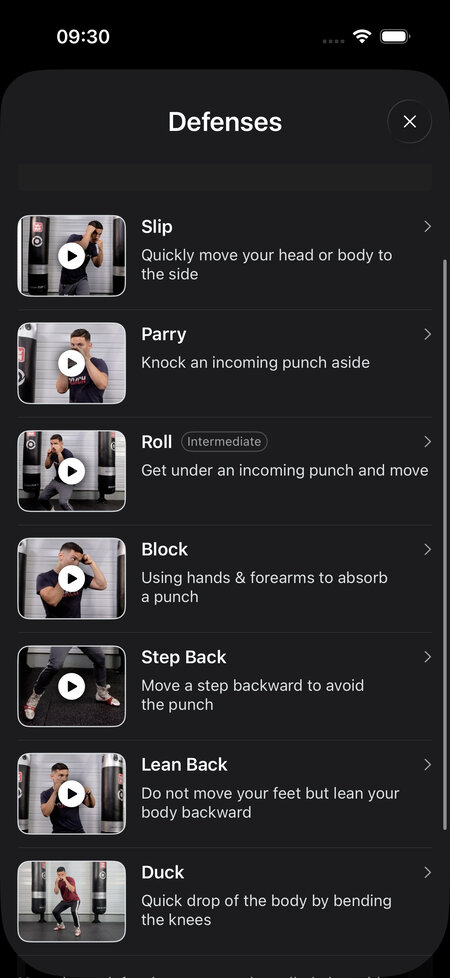
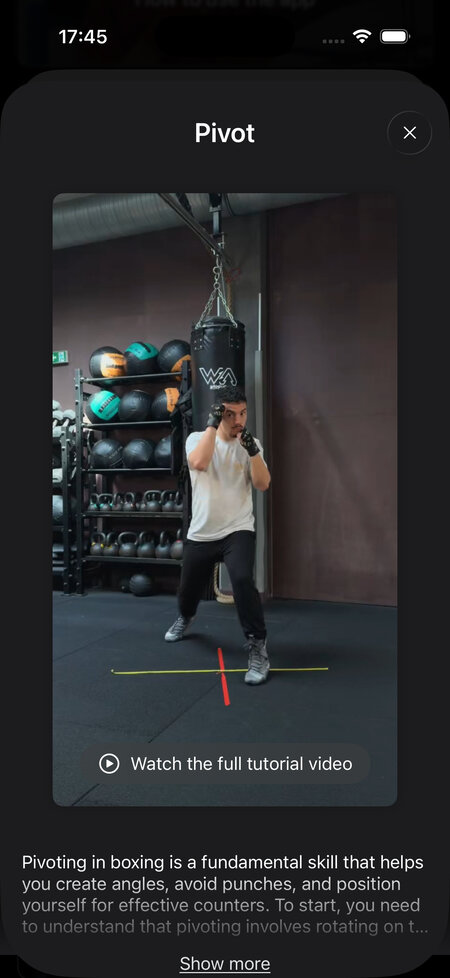
Reading “throw a cross” means nothing if you have never seen one. This is where the technique library does the heavy lifting. Every punch, defense, footwork move, and stance in the app has a tutorial video attached, so you can see the movement before you try it and go back to it whenever something feels off.
Plenty of people learn boxing basics from free videos alone, and it works. If you are disciplined, you can find good coaches on YouTube and drill along with them. We even wrote up some of the best boxing tutorial videos worth watching. The problem with going video-only is not the quality of the videos, it is you. It is very easy to watch three tutorials, feel like you learned something, and then never actually put in the reps. That is the real gap an app closes.
Where an app keeps you showing up
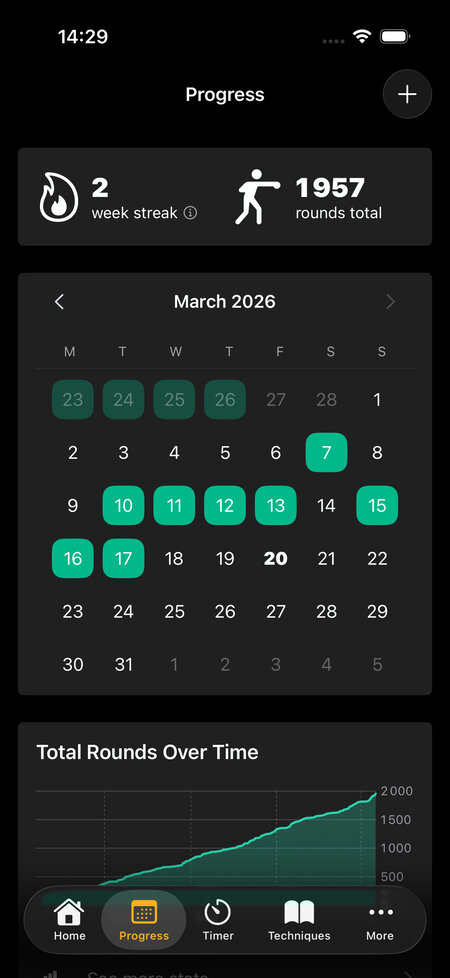
The hardest part of learning boxing on your own is not the technique. It is showing up next week, and the week after. An app tracks your streak, remembers where you are in a program, and hands you the next session so you never have to decide what to do. That small nudge is the difference between quitting in three weeks and still training in three months.
The app also plays the role of a coach during the workout itself. It calls out combos in real time, shows a coach demonstrating each exercise on screen, and keeps the round timer running so you are training at boxing’s actual pace instead of standing around thinking. We went deeper on this in our piece on the coaching built into the app, and it is a big part of why the app feels less like a video and more like a session.


A real coach is still better, so use both
Here is where an app hits its ceiling. If you can afford a good coach and a gym, do that too. A coach sees the mistakes you cannot feel, adjusts your stance with their hands, and holds pads so you learn timing and distance against a moving target. No app replaces that.
But this is not an either-or. The smartest way to learn is to use both together. Train with your coach once or twice a week, then use the app on the days you are alone to drill what they taught you. Your coach fixes your hook on Monday; you throw 200 more of them at home on Tuesday and Thursday so it is locked in by your next lesson. The app becomes your homework, and you show up to every session sharper because of it.
If you have no coach and no gym nearby, an app plus a mirror or a phone camera to film yourself is a completely legitimate way to start. Film a round of shadow boxing, compare it against the technique videos, fix one thing, repeat. That loop alone will make you better.
Can’t AI just watch you and correct your mistakes?
It is the obvious question, and we get it a lot. If a phone can track your face for a video call, surely it can watch you punch and tell you what you are doing wrong? Or a sensor in your glove, or a camera pointed at your bag? The honest answer today is no, not well enough to trust.
We have tested a lot of the existing solutions, and we have built our own prototypes to see how far we could push it. They all work some of the time. They can count your punches, roughly guess a jab from a hook, and tell you how fast your hands are moving. That part is fine. The problem is that good boxing lives in details that these systems just cannot see yet.
Think about what actually makes a punch correct. Is your rear shoulder rotating through the shot or are your arms doing all the work? Is your lead shoulder slightly raised to protect your chin? Did your guard come back up the instant the punch landed, or did it drift? Are your feet set so you could throw the next one? A coach catches all of that in a glance. A simple video or a chip in your bag cannot, and when the feedback is confidently wrong, it is worse than no feedback at all because you drill the mistake in.
Maybe this changes. The technology is moving fast, and if it ever gets good enough to actually help instead of mislead, we will build it into the app and tell you plainly when it is ready. For now we would rather be straight with you than sell a feature that does not work.
What about punch trackers and other hardware?
Punch trackers are a different tool, and some of them are genuinely fun. A sensor that measures how hard you hit and counts your punches gives you a number to chase, and chasing a number can be great motivation over a few months. If that keeps you coming back to the bag, it is doing its job.
But keep the limit in mind: hardware like that measures output, not form. It can tell you a punch was fast or heavy. It cannot tell you your hip rotation was right, that your guard stayed up, that your chin was tucked and your head off the center line, or that you stepped back into a good position after the punch instead of standing there flat-footed. Those are the things that decide whether your boxing is any good, and a power sensor is blind to all of them. You can rack up big numbers with sloppy technique and the tracker will happily cheer you on.
So treat trackers as a motivation and cardio tool, not a technique coach. One day we would love to see hardware that reads real form, and if it arrives we will be first in line to try it.
The one thing you can’t get alone: an opponent
Here is the real limit, and it is a big one. If you only ever train by yourself, you are missing half of what boxing actually is: someone in front of you trying to hit you back. You can learn every punch, get in great shape, and have a lot of fun doing it, but a heavy bag doesn’t punch back, and a phone screen never fires a counter when you drop your guard.
That matters because a huge part of boxing lives in reactions you cannot practice solo. Reading a feint, adjusting distance as someone steps in, keeping your guard up when you are tired and getting touched, timing a slip to a real punch instead of an imaginary one. None of that shows up until there is a live person across from you. Solo work builds the tools; sparring teaches you when and how to use them.
So set your expectations right. Training on your own with an app will make you fit, coordinated, and technically sound, and for a lot of people that is exactly what they want. But if your goal is to actually box, at some point you need rounds with a partner, ideally under a coach who can keep it light and safe while you learn. Do the solo work to arrive prepared, then let sparring turn that preparation into real skill.
So, can you learn boxing with an app?
Yes. You can learn the fundamentals, build real coordination, and get in genuine shape without ever setting foot in a gym. Pair it with a coach when you can, lean on free videos when they help, and let the app do the one thing it is best at: getting you to actually train, consistently, over months. If you want to see how far it takes you, we put together a full rundown of the best way to learn boxing with an app.