
Boxer A vs Boxer B: Sparring Exercises Where Each Person Has a Job
Most light sparring has one weakness: both people are trying to do everything at once. Attack, defend, move, counter, all in the same round, which means nobody gets many reps of anything. Boxer A vs Boxer B exercises fix that by splitting the round in two. One person gets a job, the other gets the opposite job, and you swap halfway. It’s the format coaches have used forever to teach one thing at a time inside live sparring, and it’s the backbone of the partner workouts we recently added to the Shadow Boxing App.

How the format works
Before the round starts, each boxer is given a role. Boxer A might be told “only single jabs to the head”. Boxer B might be told “defenses and head movement only”. The bell goes, and for the first half of the round that’s all either of you does. Then there’s a signal, you swap, and now you’re the one slipping jabs. Rest, and the next round gives you both a new pair of roles.
Two things make this work. First, the constraints are asymmetric, so the round has a shape: someone is driving and someone is answering. Second, the swap means nobody spends three minutes only defending, which gets boring and, worse, teaches you to be passive. Everyone attacks, everyone defends, and everyone gets a concentrated dose of one skill instead of a thin spread of all of them.
In the app, the coach’s voice reads both roles before the bell, calls the swap, and hands out the next pair at the rest. It is guided light sparring, which means the power stays low and the rules do the work. You need a partner with some boxing experience, gloves, a mouthguard, and headgear if there’s any head contact.
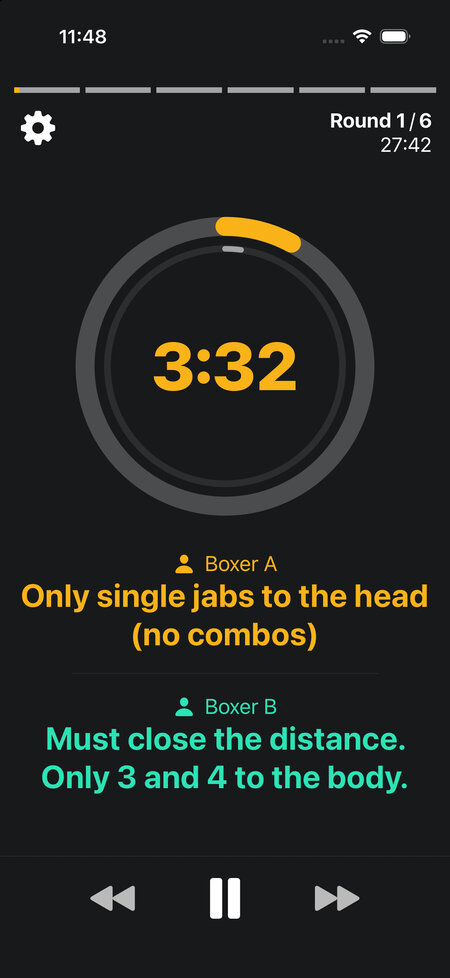
Example: countering the jab
This is the one we’d start with. Boxer A can only throw single jabs to the head, no combinations. Boxer B can only defend, with blocks, parries and head movement, and cannot punch back at all.
It sounds one-sided, and for the first half it is, on purpose. Boxer B gets to watch a jab come at them forty times with no pressure to answer, which is how you actually learn to see it. Boxer A, meanwhile, finds out how hard it is to land a single jab on someone who is only watching for it, and starts having to use feints, timing and footwork instead of volume.
Then the roles evolve over the next rounds. Boxer A adds jabs to the body, and Boxer B is now allowed to punch, but only as a counter, never as a lead. That’s where counter punching stops being something you drilled on a bag and becomes something you do against a real jab. By the third version, A can throw 1-2s and B is countering everything, which looks a lot like regular sparring but with one person clearly on offense and one clearly on the counter.
Example: closing the distance
This one is for two boxers with different natural ranges, which is most pairs. Boxer A is told to stay long and throw only single jabs to the head. Boxer B has to close the distance and can only throw hooks to the body.
The long boxer learns to use the jab as a barrier, and learns quickly that a lazy jab is an invitation for someone to step inside it. The short boxer learns the hard part of inside fighting: getting through the jab without eating it, and then having a reason to be in there, which here is the body shot. Later versions open it up: A can throw 1-2s, B can target the body with anything, and eventually both freestyle with one instruction each, stay long versus get inside. It’s the same tactical problem you’d face against a taller opponent, rehearsed under rules that keep it safe.
Example: pressure vs movement
The starting version has no punches at all. Boxer A can only move forward and try to corner Boxer B. Boxer B can only use footwork to escape. Nobody who has done this once thinks it’s easy. Cutting off a ring against someone who doesn’t want to be caught is exhausting, and backing up in a straight line puts you on the ropes in about four seconds.
The next rounds let A jab while pressing, then throw 1-2s, while B gets to jab on the way out. By the end you have a proper pressure fighter against a proper mover, and both of you know exactly which one you’d rather be.
What else is in there
The other themes follow the same logic: one person leads with straights while the other leads with hooks, one attacks the body while the other keeps the elbows tight and counters, one throws only to the head while the other can defend with nothing but slips and rolls. Every theme has three levels, so the roles get looser and more realistic as the rounds go on.
In the app there are three workouts built on this format. Boxer A / Boxer B gives you a fixed pair of roles per round. The Progression version starts each theme at its simplest and ramps it up over the session, which is the one we’d recommend for most pairs. And there’s a 12-round version for people who want a full session of it.
A few things to keep in mind
The point of a role is to make you bad at something on purpose. If you’re Boxer B and you’re only allowed to defend, you will get hit, and that’s fine, because the alternative is never learning to see the punch. Resist the urge to sneak in a counter when the rule says you can’t. Your partner is trusting the constraint as much as you are.
Keep the power where you agreed it would be. Asymmetric rounds can make the attacking boxer feel like they have a free shot, and they do not. The person defending has agreed to eat some jabs at 30 percent. They have not agreed to eat them at 70. If that starts drifting, sparring etiquette says you say something, immediately.
And swap fairly. If the round is two minutes, the signal comes at one. Nobody gets to be Boxer A all afternoon.