Boxing With Your Hands Down: Good Idea or Bad Idea?
Everyone is told the same thing on day one: hands up, chin down, elbows in. Then you watch Roy Jones Jr. fight with his hands hanging by his waist, dodging everything and landing shots from angles nobody saw coming, and the rule starts to look optional. Boxing with your hands down is the style that breaks the first thing you were ever taught. It can be brilliant, it can get you hurt, and it is one of the more fun things you can mess around with once you have a base.
What “hands down” actually means
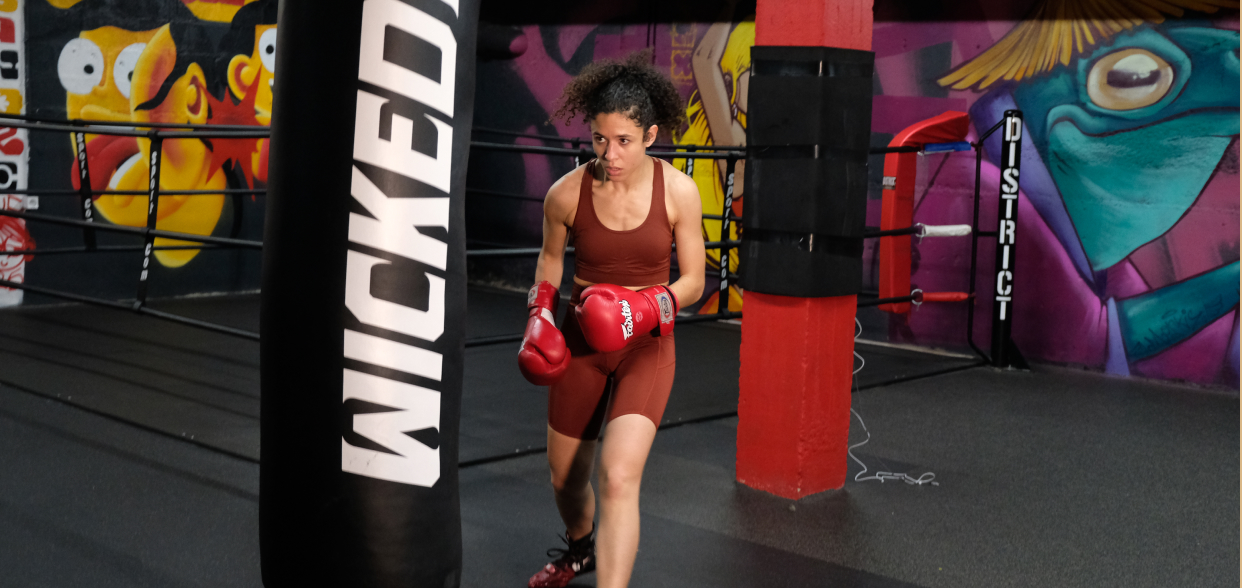
The high guard keeps both gloves up by your cheeks so you can block or parry whatever comes at you. The hands-down approach lowers them, sometimes to chest level, sometimes all the way to your hips, and trades that wall of gloves for movement. Instead of catching punches on your arms, you avoid them: slipping your head off the centre line, pulling back out of range, rolling under hooks, leaning your weight away. Your chin still tucks and your shoulders stay busy. The difference is that your defense now lives in your feet, your waist, and your reflexes rather than in a tight shell of gloves.
That is the whole gamble in one sentence. You give up the easy safety of a guard and bet that you can read shots early enough to not be there when they land.
Why it can be good
There are real reasons fighters drop their hands, and they have nothing to do with looking cool.
Your punches come from unexpected places. A jab thrown from hip height travels on a line your opponent is not used to tracking, and the same goes for an uppercut that starts from down low. Hands that are already low do not telegraph the way a punch loaded from a high guard sometimes does.
It baits people into committing. A low lead hand is an open invitation, and a lot of opponents cannot resist throwing at the gap. The moment they do, they are out of position and you have a clean read on a counter. Good hands-down fighters are not being careless, they are setting a trap and waiting for someone to step in it.
It forces you to actually use head movement. When the gloves are not there to bail you out, you have no choice but to slip, pull, and roll for real. A lot of boxers think their defense is sharp until they take the guard away and discover they were leaning on it the whole time. Dropping your hands in training is a brutally honest test of whether your defensive movement holds up on its own.
Why it is usually a bad idea
Now the other side, because it is heavy.
Your head is exposed and the path to it is short. A quick jab to the eye, a long hook coming over the top, a lead uppercut on the inside: all of them have a clean lane to your face, and you are betting your reflexes get your head out of the way every single time. Against someone fast, or someone who fights at angles, that bet does not always pay.
It only works if your reading is already excellent. The fighters who pull this off are processing their opponent’s shots almost before they leave, deciding in a fraction of a second what to slip and what to pull away from. That layer of timing is not something you can fake by copying the posture. Stand there with your hands low and average reflexes, and you are not boxing clever, you are just getting hit cleanly and often.
This is the same trap as the Philly Shell, the bladed shoulder-roll stance. Both look relaxed and economical in the highlight reel, and both are sitting on years of sparring that built the timing underneath. The posture is the easy part. The reflexes are the whole thing.
The Cuban connection and the showmen
A lot of the relaxed, hands-lower look traces back to the Cuban amateur school. Cuban boxing leans on loose movement, feints, pot-shots from odd angles, and pulling back out of range instead of blocking. Guillermo Rigondeaux is the textbook version: hands low, almost still, then a single counter that lands before you registered he had moved. That same DNA shows up in the bouncing, hands-relaxed rhythm of fighters like Vasyl Lomachenko.
Then there are the pure entertainers. Roy Jones Jr. and Prince Naseem Hamed both made the hands-down style look like a magic trick, switching from flashy to vicious in the same beat. The thing people forget is the athleticism and timing they were both sitting on. The flash worked because the fundamentals underneath it were extraordinary, not because the fundamentals had been skipped.
Why it is genuinely fun
Here is the part nobody tells beginners: playing with your hands down is a great time. There is something loose and expressive about it that a tight high guard does not give you. You start feeling out distance, baiting, pulling, countering, and boxing stops being a checklist of combos and starts feeling like a conversation. The app even nudges you toward it during warmups, where one of the shadow boxing callouts is simply to box with your hands down for a round and feel what changes.
The smart way to use it is to mix it in, not to live in it. Spend a freestyle or shadow boxing round with your hands low, get used to relying on movement, then snap back to a tight guard when you want the safety. Switching between the two on purpose makes you a more unpredictable boxer and a sharper defensive one, because you stop depending on the gloves as a crutch. Treat it as one gear out of several rather than your whole identity.
How to try it without getting cracked
Build it in stages instead of dropping both hands in your next spar.
Start in shadow boxing, where the cost of a mistake is zero. Throw your punches from low, practise slipping and pulling as if real shots were coming, and get the rhythm into your body. Move it to the bag next, working low-hand counters and head movement around it. Only after that should it touch live sparring, and even then go in against lighter, slower partners first.
When you do spar with it, drop the lead hand only and keep your rear hand glued near your chin as a safety net. The rear hand is your last line against the big shot, so it stays home while the lead hand experiments. Be honest with yourself about whether the defense is actually working or whether you are just getting away with it against someone who is not pushing you. The day a sharper opponent starts landing, put the guard back up and live to play another round.
Find it in the app
The hands-down style sits in the Shadow Boxing App inside the technique catalogue under Stances, with a short tutorial video and a written breakdown of where the hands sit and how to stay safe with them low.
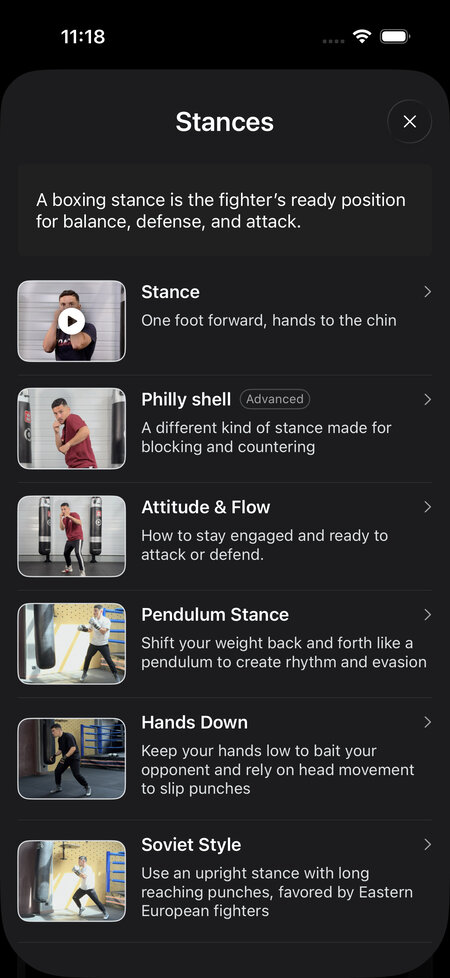
The Stances section lines up the other ready positions next to it: the standard Stance, the Philly Shell, Attitude & Flow, the Pendulum Stance that the Cuban-influenced fighters favour, and the upright Soviet Style. Each has its own tutorial, so you can watch the hands-down approach against the rest and see exactly what you are trading away. If you want the wider tour of punches, defenses, and footwork in one place, the technique catalogue overview covers all of it.