
The Philly Shell: Why It Looks Easy and Is Not
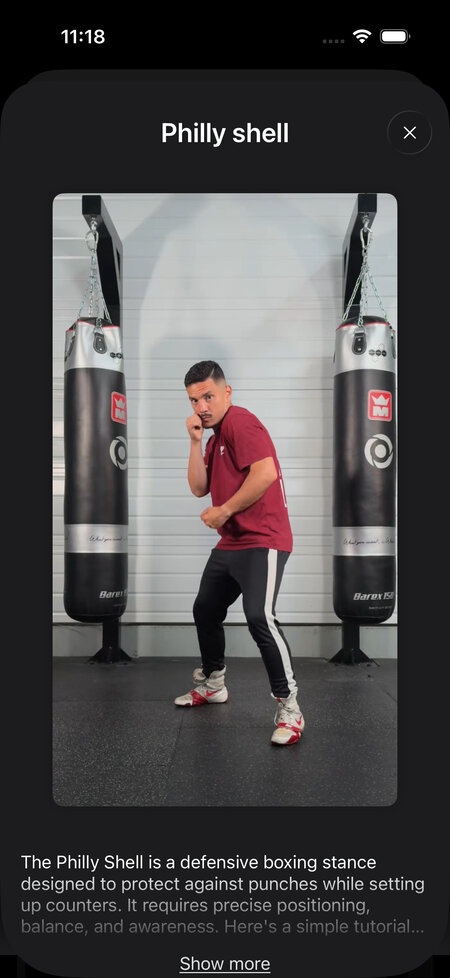
The Philly Shell is the stance you have seen on a hundred YouTube highlight reels. Lead shoulder up by the chin, rear hand glued to the cheek, lead hand resting across the belt line, body bladed so the front of the torso is almost facing the wall instead of the opponent. It looks relaxed. It is anything but.

People copy it because it looks cool and because the names attached to it are good ones: Mayweather, James Toney, Bernard Hopkins, a long line of Philadelphia gym fighters before them. The problem is that the stance is essentially a frame for a specific way of fighting, and if you do not have the reflexes and the timing for that style, you are just standing there with your lead hand down getting hit.
What the Philly Shell actually is
The mechanics are simple to describe and very hard to perform. You blade your body so your lead shoulder points toward your opponent. The lead shoulder comes up to cover the chin, and you tuck your jaw behind it. The rear hand sits high on the cheek as a permanent guard for the side of the head. The lead hand drops to the body, sometimes across the stomach, sometimes resting on the lead hip.
The defensive idea is that incoming punches either get rolled off the lead shoulder, parried by the rear hand, or absorbed by the lead arm wrapped across the body. Your head moves off the centre line by leaning back from the waist, and your counters come from very short, very fast back-hand shots over the top.
Why it works
When the Philly Shell works, it is gorgeous to watch. There are a few real reasons it can be effective.
The lead shoulder roll takes the straight right hand out of the fight. If your opponent is committed to throwing crosses down the pipe, you can roll them off the shoulder all night and counter with a check hook or a back-hand right of your own.
It is economical. You are not bouncing, you are not throwing wide combos, you are not burning energy on defensive movement that takes you out of range to counter. Everything is short. Your hands are already in counter position, so you do not need to recover from a tight guard before firing back.
It rewards reading. A fighter who is good at the shell is reading the rhythm and the tells of the person across from them and timing single shots into the gaps. When that read is correct, the counters land cleanly because there is no wasted motion in between.
Why it is bad for most people
The downsides are heavy enough that almost every coach who teaches it will tell you to learn the orthodox stance first.
The lead hand is low. That sounds obvious because you can see it in any photo, but it matters: a fast jab to the eye, a long left hook over the top, or a lead-side uppercut on the inside all have a clean path. You are betting that your head movement and your lead shoulder will get there in time. Against a fighter with good speed and good angles, that bet does not always pay.
The output is limited from the lead side. You can throw a check hook and a lead uppercut, but the rangy jab that most boxers rely on to control distance and set up combinations is not there in the same way. You are giving up a tool, and you need to make that worth it through what you do with the back hand and the counters.
It is a counter puncher’s stance. If you are not naturally a counter puncher, or if you are matched against someone who refuses to lead, the shell can leave you flat-footed and reactive in a fight where you needed to be the one walking forward.
Why it is hard
The reason this stance is hard is not the position itself. Anyone can stand bladed with their shoulder up and their hand on their hip. The hard part is the reflex layer that has to sit on top of it.
To use the shell you need to read punches almost before they leave. You need to know which shots to roll, which to parry, which to lean away from, and you need to decide that without thinking. You need to feel where the opponent’s lead foot is and what they are setting up. None of this is taught by holding the stance. It is built over years of sparring, getting hit, getting hit a little less often, and slowly building the timing.
That is why the stance shows up at the professional level and almost never below it. The fighters you see using it well have done the reps in the gym to make the timing automatic. Putting a beginner in the shell is putting them in a frame they cannot fill yet.
It is in the app’s technique catalogue
You can find the Philly Shell inside the Shadow Boxing App, in the technique catalogue under Stances. The page has a short tutorial video showing the position from the side, plus a written breakdown of where the hands and shoulders sit.
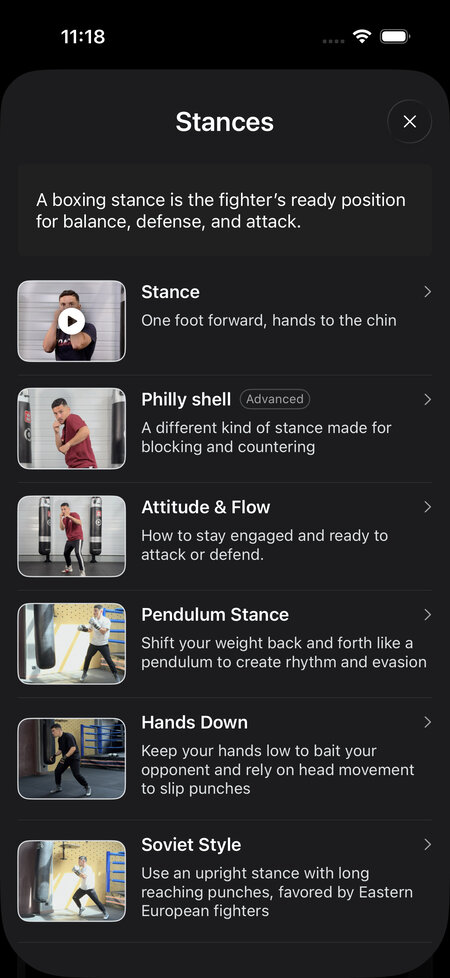
The Stances section also lists the other ready positions used in boxing: the standard Stance, Attitude & Flow, the Pendulum Stance, the Hands Down style, and the Soviet upright stance with its longer reach. Each one has its own tutorial and explanation, so if you are curious about how Philly Shell compares to, say, the hands-down approach Roy Jones used, you can sit them side by side and watch both.
If you want a broader tour of what else is in there, the technique catalogue overview covers punches, defenses, and footwork in the same place.
Start with the basic stance
If you are early in your boxing journey, learn the standard stance and stick with it. Lead foot forward at roughly a 45 degree angle, back foot at about shoulder width behind it, weight balanced, both hands up by the cheeks, elbows in to cover the body. That stance gives you the full toolkit: a long jab, a strong cross, hooks and uppercuts from either side, and a tight guard that does not require split-second reading to keep you safe.
Once that base is solid, the orthodox stance is the foundation you experiment from. You can borrow ideas from the Philly Shell, like keeping your lead shoulder ready to roll a straight right when one is coming, without committing to the full bladed posture and the low lead hand.
If you do want to try the shell, do it in shadow boxing first, then on the bag, before you ever take it into sparring. Throw the back-hand counters from the shoulder-roll position. Practice leaning back from the waist instead of stepping back. Get the timing wrong a hundred times with no one in front of you, then build from there. The basic defense techniques you have already drilled will still apply, and they will give you a fallback for the moments when the shell does not save you.