
Shadow Boxing or Heavy Bag: Which Should You Train?
If you train at home, you have probably wondered whether to invest in a heavy bag or just keep shadow boxing. Or if you already have one, whether you should be splitting your time differently between the two. They are not interchangeable, and understanding what each one develops helps you use both better.
What shadow boxing does well
Shadow boxing is the more technical of the two. Without a target, you have to generate your own feedback: does that combination feel clean? Am I balanced after the cross? Am I actually slipping or just leaning?
It is the best tool for working on movement, footwork, defensive head movement, and flow. You can throw the same combination 40 times in a round without needing anyone or anything to hold still for you. You can work at any intensity, including very light and technical sessions where you are thinking through every movement.
Shadow boxing also trains your ability to set things up in your head. You imagine an opponent, you feint, you create angles. That mental side of boxing, reading distance and timing, is easier to develop when you are not reacting to the physical stimulus of a bag in front of you.
The limitation is feedback. You never really know if your punches would land or have power, because nothing is stopping them.
What the bag does well
The bag provides resistance and physical feedback that shadow boxing cannot replicate. You feel immediately whether your hip rotation is generating power, because the bag tells you. You build hand conditioning. You learn to punch through a target rather than at it.
The bag is also better for conditioning at high output. Going hard on a bag for three minutes is a different physical experience from shadow boxing for three minutes. The resistance makes your muscles work harder, and the impact feedback can drive intensity in a way that shadow boxing sometimes does not.
Bag work also builds the commitment to land punches. Shadow boxers who have never worked a bag sometimes develop a habit of pulling short, because there is no consequence for not reaching the target. The bag fixes that.
Where each one falls short
Shadow boxing does not build power or conditioning at the same rate as bag work. It also does not develop the habit of punching through resistance. If someone only ever shadow boxes, their punches can become a bit light and uncommitted.
Bag work does not develop movement or defensive technique as naturally. It is easy to stand in front of a bag and load up on punches without moving your feet or slipping between combinations. The bag does not require you to do anything other than punch it.
Using both together
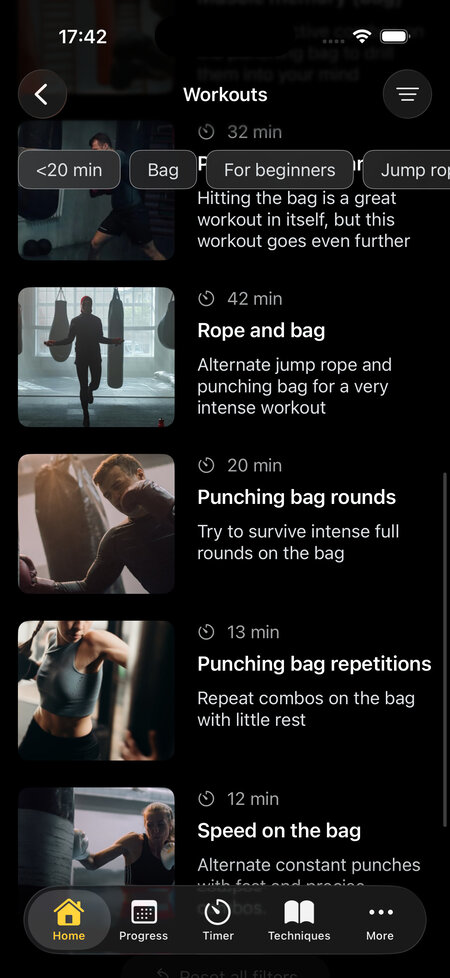
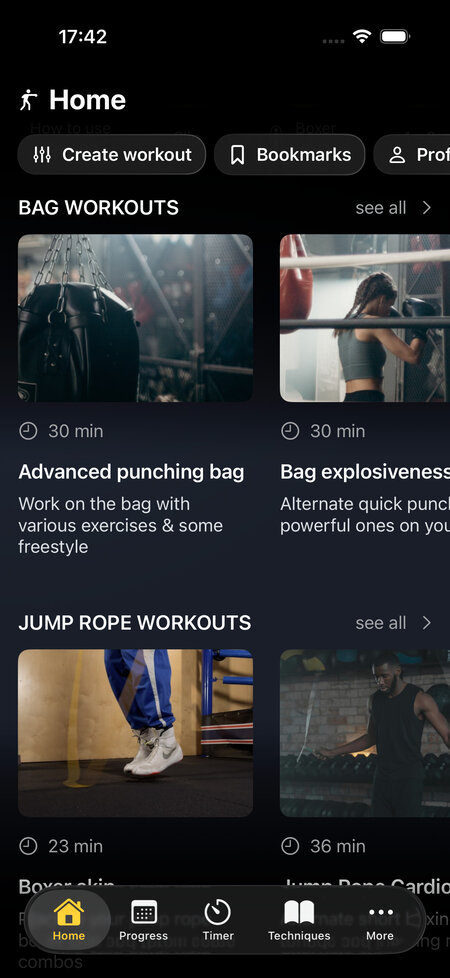
The most effective home training uses both, and the Shadow Boxing App supports both. All exercises in the app work as shadow boxing, and the bag-specific exercises in the workouts and the bag training section are built for the physical demands of hitting something.
A practical split for a training week: use shadow boxing sessions for technical work, footwork, and lighter days. Use bag sessions when you want to go hard, build power, or drill a combination with real feedback. The two complement each other better than either does alone.
If you do not have a bag and are deciding whether to get one, the honest answer is that shadow boxing alone can take you a long way. The bag adds something real, but it is not required to train seriously. Start with the app and shadow boxing, and add the bag when you want to push conditioning and power specifically.