
Jump Rope Techniques in the App: What Each Level Covers
Most boxing apps treat jump rope as a timer: start the rope, wait for the round to end. The Shadow Boxing App has a dedicated jump rope technique section in the technique catalogue that covers actual skills, from the first jump through to advanced tricks. The workouts and exercises you get adjust to the level you have set in your profile.
Here is a look at how the technique progression works. The app covers more techniques than what is listed here, but these give a clear picture of what each level involves.

Level 1: Just starting
If you have never jumped rope before, the app flags this and points you toward the beginner program before jumping into workouts. There is no technique to catalogue yet because the first step is just getting comfortable with the rope turning and your feet leaving the ground consistently.
The Learn to Jump Rope program covers this stage specifically.
Level 2: Beginner
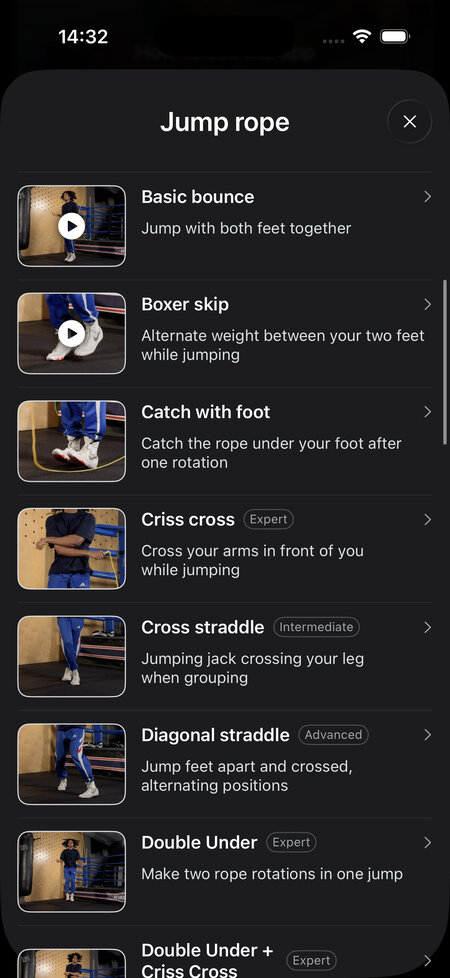
Normal jump. Both feet together, landing and leaving the ground at the same time with each rotation. This is the starting point for everyone.
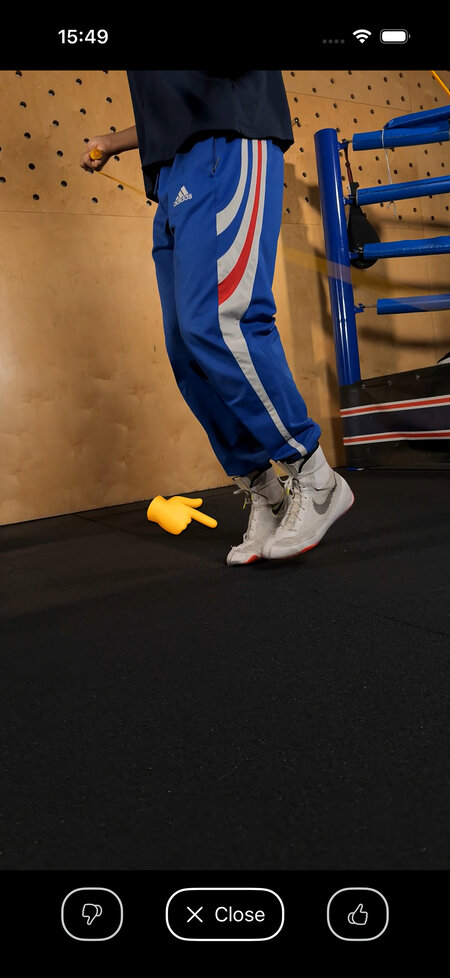
Boxer skip. Alternating weight between feet with each rotation, like a subtle running motion. It is more sustainable than the basic bounce over multiple rounds and is the technique you will see in almost every boxing gym. The app has a full tutorial video for the boxer skip and it features in dedicated workouts once you reach this level.
Level 3: Intermediate
Side jump. Jumping laterally rather than in place, shifting your landing point left or right with each rotation. This adds footwork to the rope and starts connecting jump rope movement to boxing movement patterns.
Straddle variations. Side straddle, forward straddle, and diagonal straddle, landing with feet apart and then together in different directions. These demand more coordination and add variety to longer rope rounds.
The app also uses floor markers at this level: making a circle or line on the ground to give your footwork a reference point. Small circle to step in and out of, large circle to run drills around. There are more intermediate techniques in the catalogue beyond what is covered here.
Level 4: Advanced
A few examples from this level: heel and toe work and side swings. These require the rope to be controlled precisely rather than just turned rhythmically: you are varying where the rope passes relative to your feet and using the handles for swing patterns that are not full rotations. The app has a wider range of advanced techniques; these are representative of the step up in difficulty.
At this level the jump rope work starts to look genuinely skilled rather than just conditioned.
Level 5: Expert
Criss cross. Crossing your arms in front of your body mid-rotation so the rope forms a loop you jump through, then uncrossing for the next rotation.
Double under. The rope passes under your feet twice in a single jump. This requires significantly more explosive power and wrist speed than any of the lower-level techniques.
Both are genuine skills that take dedicated practice. They are the headline techniques at expert level, but not the only ones: the app’s catalogue goes further, and the adaptive exercise pulls from the full pool to select movements appropriate to what you have said you can do.
How the level setting works
The jump rope level you set in your profile determines which exercises and workouts the app includes. Setting it accurately matters: if you put yourself at expert when you are actually at beginner, the workouts will call techniques you cannot do yet. If you underrate yourself, you will not get the variety and challenge the app can offer.
Update it when you genuinely move up: when the boxer skip feels natural and consistent, move to intermediate. When side straddles are comfortable, move to advanced. The setting is there to match training to where you are, not to reflect aspiration.