
Feints in Boxing: What They Are and How to Practice Them
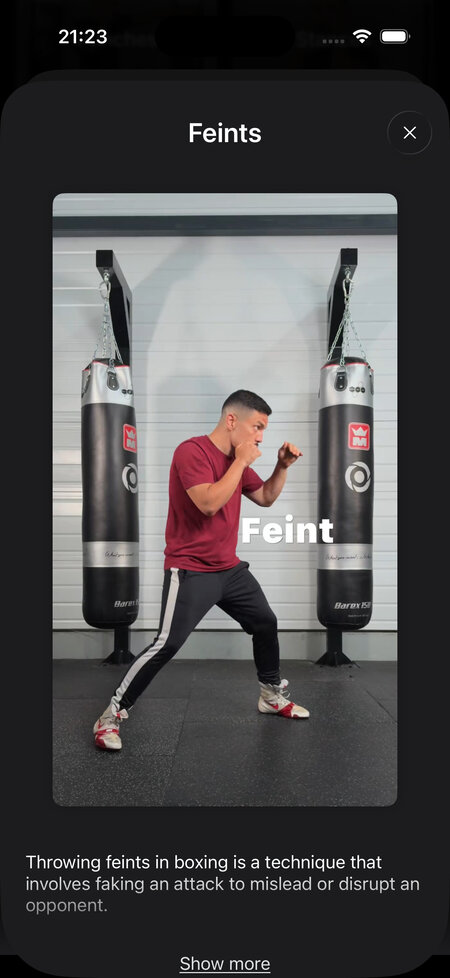
A feint is a movement that looks like a punch without being one. The goal is to make your opponent react defensively to something that is not coming, which creates an opening for what actually is.
At its core, feinting is about information and deception: you are trying to find out how someone defends and simultaneously create the gap you need to land.

Why feints work
When a punch comes at you, you respond. That response takes time and commits your guard to a position. A feint exploits exactly that: if you can get a genuine defensive reaction from a fake attack, you have a window while their guard is adjusted to the wrong threat.
The feint works because it needs to look real. A half-hearted, unconvincing movement does not provoke a reaction. The best feints use the same body mechanics as the actual punch, just stopped short: the shoulder rotation of a jab, the weight shift of a right hand. If it looks like a punch, it gets treated like one.
Types of feints
Punch feints. Extending the lead hand as if throwing a jab, or rotating the shoulder as if the cross is coming. The most common and the most useful starting point.
Level changes. Dipping as if going to the body, then coming up to the head. Or vice versa. Once an opponent starts watching for body shots, their head becomes less guarded.
Feint to the body, punch to the head. The app specifically mentions this combination: fake a punch to the body level but actually target the head. The level change is the feint, and the guard drops to protect the body just as the real punch arrives higher.
How to practice feints in shadow boxing
The challenge with feinting is that it is inherently reactive: feints work when someone responds to them. In shadow boxing you have to imagine the reaction and build the habit of setting things up rather than just throwing.
A simple drill: throw a jab feint, pause for a beat as if watching for the response, then land the cross. The pause builds the mental habit of reading and following up. Over time, the sequence becomes part of how you construct combinations rather than something you think through consciously.
In the Shadow Boxing App the Feints exercise calls out feints alongside regular punches during a round. When the app calls a feint, you make the faking motion for that hand. When it calls a punch, you throw it. This drills the combination of real and fake attacks so they both become natural, not just one or the other.
When to use them
Feints are most effective when they are unpredictable. If you throw the same feint every time before the same punch, anyone paying attention will stop reacting after a few repetitions.
The timing also matters. A feint right as your opponent is about to commit to their own attack is more likely to provoke a response than one thrown at a random moment. Reading the rhythm of the exchange and inserting a feint at the right point is the advanced application.
Start simple: one feint type, one follow-up punch. The technique catalogue has a full breakdown of feints with video if you want to see the mechanics before drilling them, and defensive exercises in the app mix feints in with real punches so you practice both together.