
All the Ways to Train With the Shadow Boxing App
Most people assume a boxing app means punch callouts and a round timer. The Shadow Boxing App does both of those things, but the full picture is bigger. Boxing is a complete sport: technique, defence, footwork, conditioning, bag work, rope work. The app tries to cover all of it, and the list of training exercises keeps growing. Here is what is in there.

Building the fundamentals
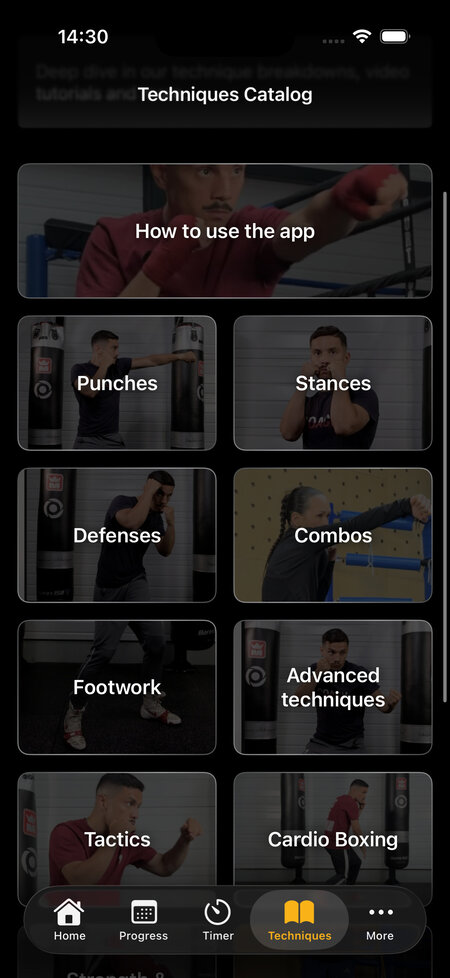
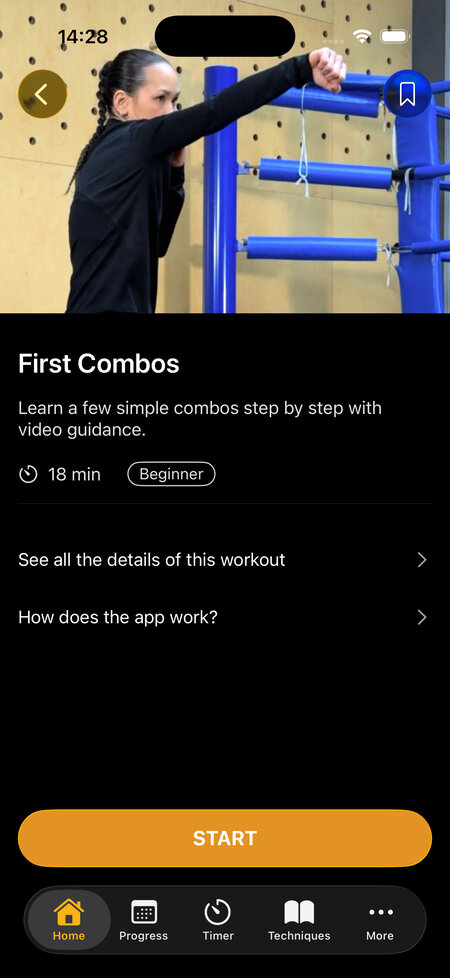
Everything starts with learning the basic punches and combinations. The Simple Combos exercise eases you in with beginner-friendly sequences, while the Foundation exercises (Foundation Jab, Foundation Cross, Foundation Hook, Foundation Uppercut) isolate each punch so you can focus on form before mixing them together.
Once the basics are in place, Repetitions gives you one combination to drill for an entire round, which is how muscle memory is actually built. Muscle Memory takes the same idea further, cycling through basic combos until they start to feel automatic. Decomposing Combos breaks longer sequences into smaller pieces so you can learn them step by step before putting them together.
For drilling combinations with more variety, Pad Work calls out combos for you to execute as they come, like working with a coach on the pads. Pad Work (freestyle) goes one step further by calling out a number of punches and letting you improvise the sequence.
Defence, counters, and head movement
Most boxing apps skip defence entirely. It is harder to teach and harder to make feel satisfying in a solo workout. We think it is too important to leave out.
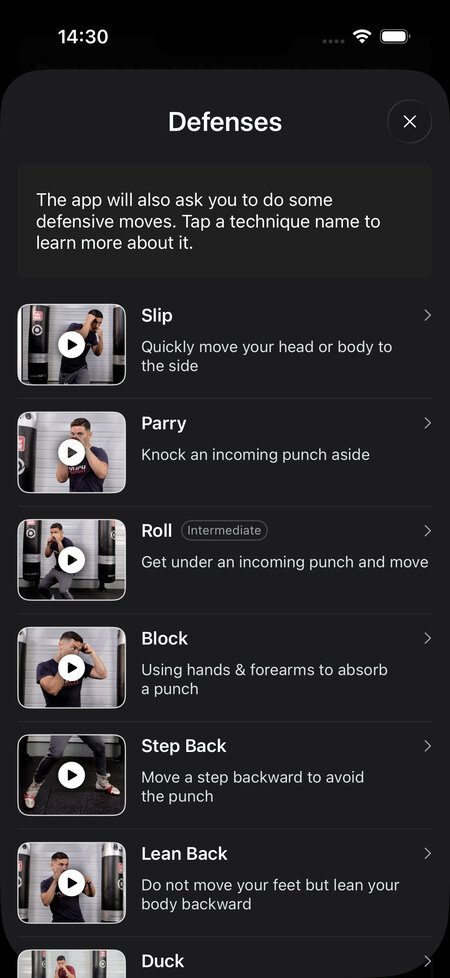
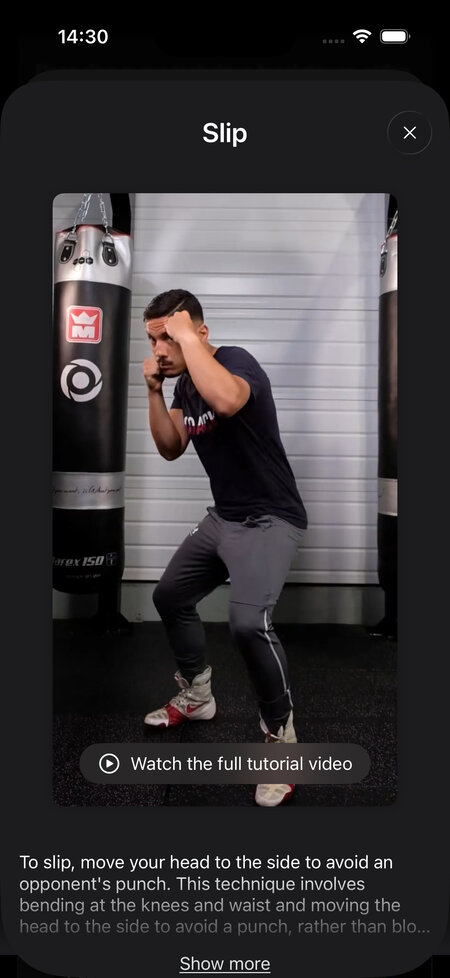
The Defense exercise builds combinations that include defensive movements alongside punches. Defense Drill repeats a few key defensive movements to build the reflex. Remember Defenses is for people just getting started with slips, rolls, and parries. Simple Defense adds basic defensive actions into standard combos.
Beyond those, there are more advanced exercises: Dodge focuses on reaction speed and countering; Counter Punching has you start with a defensive action and retaliate; 2 Phase Attacks structures each exchange as an attack, a defense, and a second attack; Hit and Get Out trains the reflex of punching and immediately creating distance. Feints works on disguising your intentions before committing to a punch.
Footwork
Footwork Drills covers the basics of stance, weight transfer, and movement. Guided Footwork pairs footwork callouts with pad work so you are moving and punching together, not separately. Advanced Guided Footwork adds defensive movements on top of that: you are moving, defending, and punching all at once.
Defensive Footwork puts the emphasis on moving to avoid punches, which is a different skill from moving to create angles. Both matter.
Punching bag
If you train with a bag, there are dedicated exercises for it. Punching Bag (explosiveness) alternates non-stop fast punches with powerful combos to build explosive output. Punching Bag (speed) alternates constant punches with fast, precise combinations. Punching Bag (focus) keeps one combination for the full round so you can drill it with full power.
For defence on the bag: Punching Bag (defense) has you slip or roll before following up with a freestyle combo. Punching Bag (evade) trains the habit of punching hard and then getting out of range. Punching Bag (reflexes) is a cardio exercise that builds reactive output.
Conditioning that fits boxing
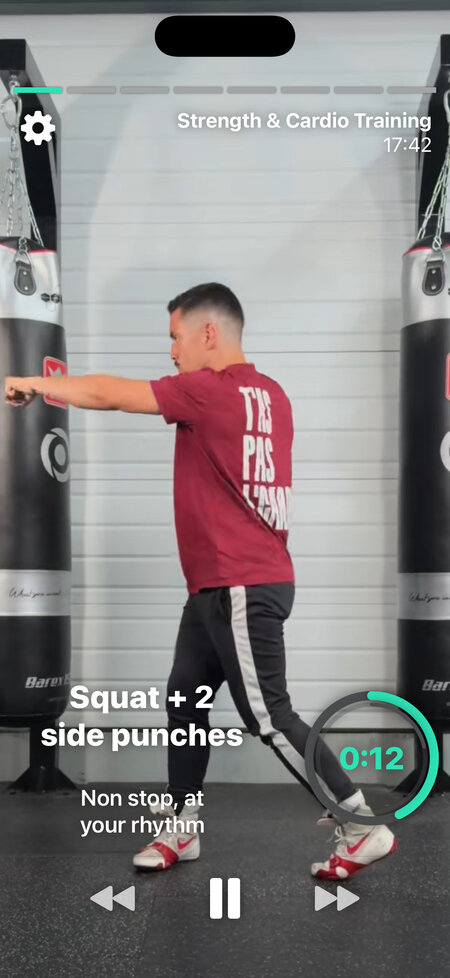
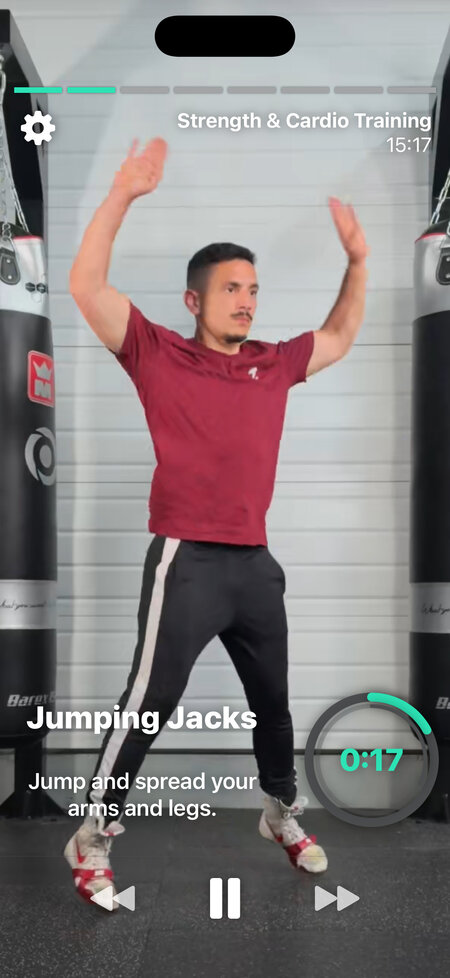
The conditioning exercises are built around movements that connect to boxing, not generic gym work dropped in for variety. There are standard calisthenics: push-ups, squats, lunges, burpees, mountain climbers, plank variations. But there are also hybrid movements that combine conditioning with boxing: High Knees with Punches, Lunges with Punches, Squat with Side Punches, Jumping Box (jumping jacks with punches), Pendulum Box, Rock Box.
Boxing + Cardio pulls from over ten of these exercises and cycles through them randomly each round, so the session stays unpredictable.
Jump rope
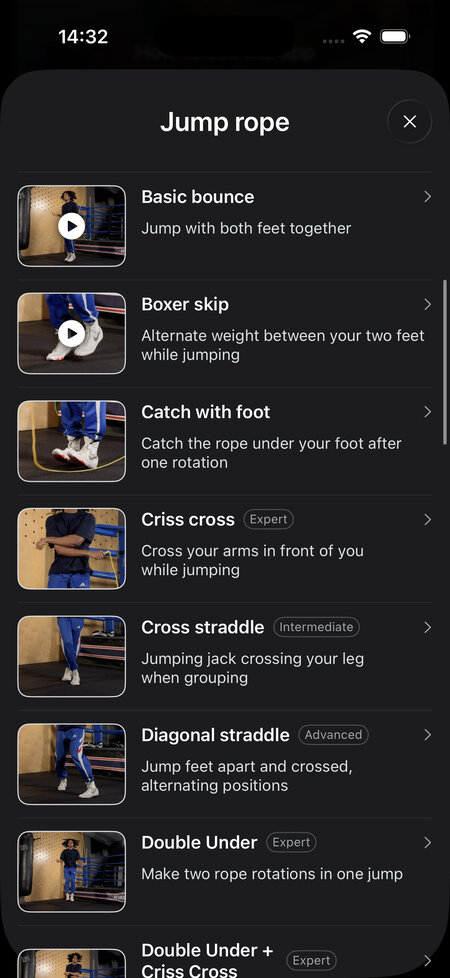
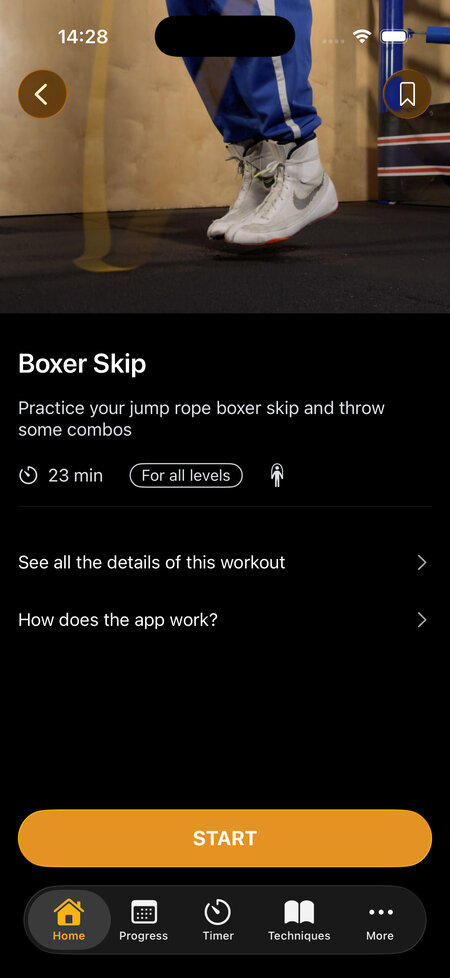
The jump rope section is its own complete system. At the beginner end: Basic Bounce, Boxer Skip, Jog in Place, Back and Forth. As you progress: Heel Taps, Toe Taps, Off Step, Side Straddle, Forward Straddle, Scissors, Skier, Twister, Ali Shuffle. At the advanced end: Double Under, Criss Cross, Double Under + Criss Cross, Swing Kick.
There are also movement-based exercises: Move Back and Forth, Step In with a Combo, Step In and Jab, which use the rope as a tool for footwork rather than just cardio. The Adaptive exercise adjusts the jump types to your current skill level so sessions stay challenging without becoming discouraging.
The full jump rope section has programs that put these exercises into structured progressions.
Kickboxing and Muay Thai
Boxing is the core of the app, but not the limit of it. Basic Kicks introduces kicks. Knees builds combos with knee strikes. Elbows adds elbow strikes. Longer Kick Combos strings them together progressively.
These exercises are there because the sport has influenced Muay Thai, kickboxing, and MMA, and a lot of people who train boxing also train those disciplines. The app tries to cover that ground rather than pretend it doesn’t exist.
Recovery and cooldown
Active Recovery lets you slow down without stopping completely, executing simple techniques at low intensity. Relaxed Punches and Light Freestyle serve the same purpose during longer sessions. For breathing: 4-7-8 Breathing guides you through a structured breath pattern to calm down after a hard round, and Deep Breaths is a simpler version for quick cooldowns.
Build your own
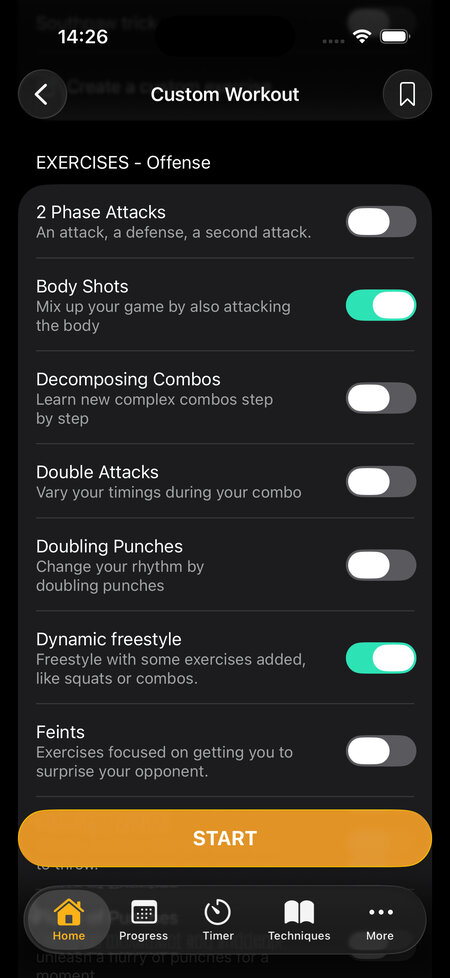
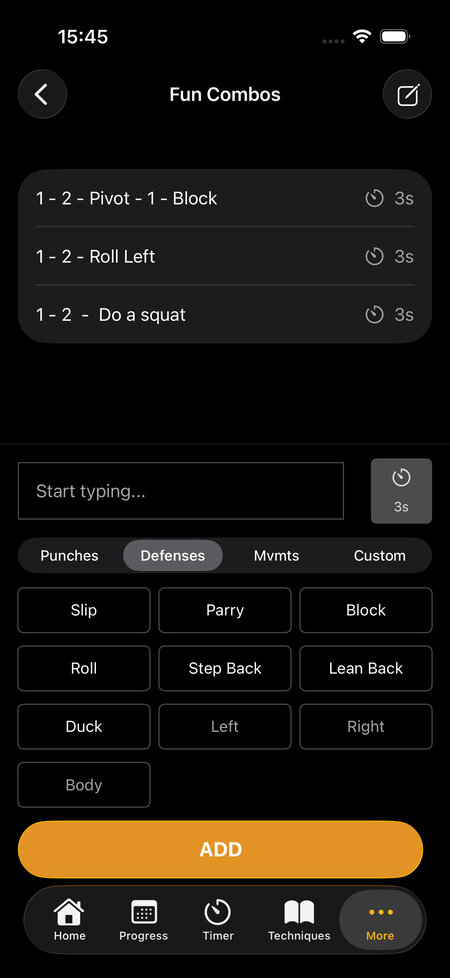
Beyond the built-in exercises, you can build sessions entirely from scratch. The custom workout builder lets you pick any combination of exercises, set the round count, timing, and rest periods. The combo builder lets you design your own sequences and have them called out during a session.
The app also lets you save and repeat workouts, so once you find a structure that works for you, you are not rebuilding it every time.
It keeps growing
The exercises listed here are what exists as of early 2026. New ones get added regularly, based on what coaches suggest, what users ask for, and what the team finds useful in their own training. The goal has always been to cover the sport properly: not just the punching, but the movement, the defence, the conditioning, and the mental side of repeating things until they become instinct.
If you have not explored the full exercise list yet, it is worth spending some time in the workout builder just to see what is there.